I need the shortest overview
Start with the one-hour talk companion, then use software and hardware basics for plain-language definitions.
Workbook site map
Use this page as a decision router: start with the question in front of you, then move into the right workbook path, case, template, library reading, or search term.
Workbook map: 30 minutes
The workbook is deeper than the one-hour talk. You do not need to read every page in one sitting. Use this map to choose the path that matches the decision you need to make now: stage, workflow, software, hardware, regulation, integration, security, funding, pricing, or launch readiness.
The strongest learning path moves from shared language to concrete decisions. First understand the system, then identify stakeholders and workflow risks, then use the specialized pages to plan evidence, architecture, security, deployment, cost, funding, and team ownership.
Start with the one-hour talk companion, then use software and hardware basics for plain-language definitions.
Open the stage planner to choose ideation, prototype, pilot, production, or scale and see the next technical and business questions.
Read getting started with engineering, then prepare a builder brief before asking for time or cost estimates.
Start with the medtech ecosystem, then read interoperability, TCO, and the CareLink integration case.
Read funding in Canada and Alberta, then use the funding stack case to compare RDII, Mitacs, IRAP, SR&ED, NSERC, SSHRC, CIHR, and Alberta Innovates.
Go to templates and workshop resources for Gantt schedules, logic models, SMART goals, PIA worksheets, SBOM inventory, V&V plans, and risk matrices.
If you are short on time, pick the row closest to your current stage and produce the artifact in the last column.
| Stage | Read first | Then read | Useful artifact |
|---|---|---|---|
| Ideation | Talk companion | Medtech ecosystem and clinical workflows | Stakeholder register and assumption log |
| Prototype | Engineering starter guide | Native vs PWA and architecture patterns | Builder brief and architecture review checklist |
| Pilot | Canada and Alberta context | V&V, deployment, and threat modeling | PIA inputs, V&V plan, and support runbook |
| Production | QMS essentials | IEC 62304, postmarket cybersecurity, and hosting costs | Release plan, SBOM, incident response plan, and cost model |
| Scale | Team and stack | TCO, funding, and founder cases | Capability map, funding stack, and procurement-ready business case |
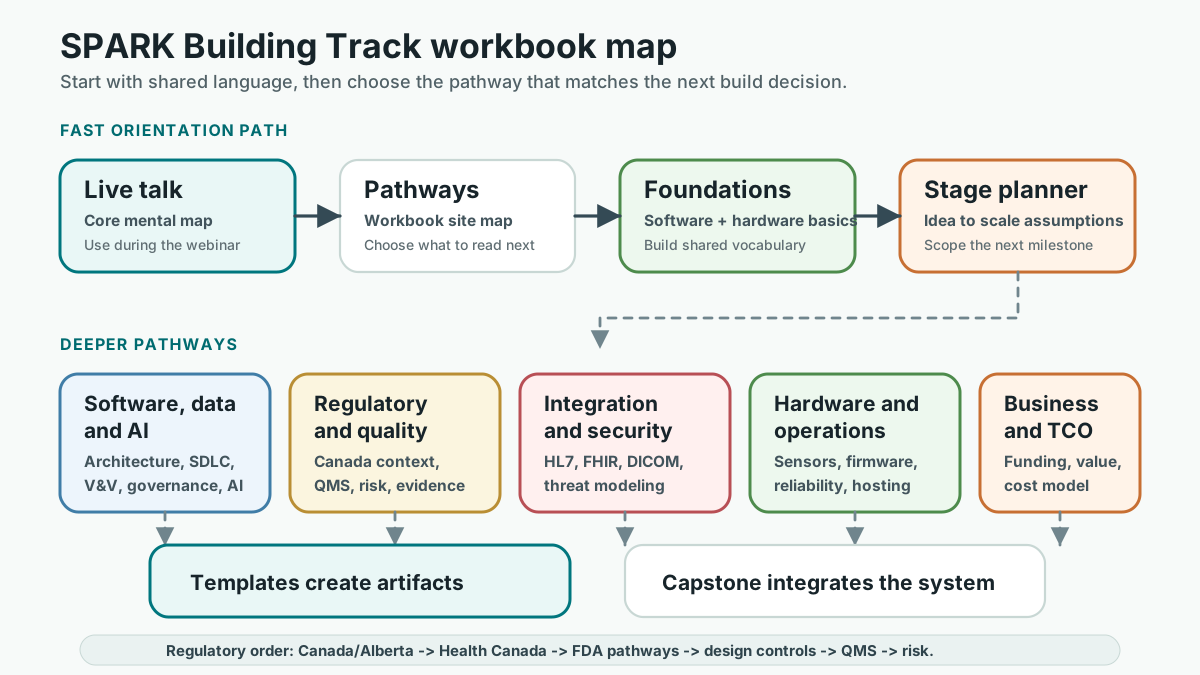
Use during the live session to keep the main concepts visible.
Choose the stage, product focus, user count, pricing model, and next technical/business pathway.
Understand how the workbook is organized and what learners should be able to explain.
Build shared language for apps, APIs, servers, databases, cloud systems, sensors, firmware, and AI-assisted prototyping.
Connect the technical product to clinical, operational, privacy, security, quality, regulatory, finance, and procurement stakeholders.
Choose this path when the product is mainly an app, dashboard, API, cloud service, data system, AI feature, or software-enabled workflow.
Getting started with engineering explains what builders need before they can estimate or build responsibly.
Native vs PWA helps teams decide between mobile apps, web apps, and hybrid strategies.
Architecture patterns explains cloud-first, edge-heavy, and hybrid system choices.
SDLC stages and IEC 62304 connect development work to controlled records and maintenance.
Verification and validation explains why demos are not enough for medtech readiness.
Data governance, AI/ML, and model monitoring cover data quality, oversight, drift, and controlled change.
Choose this path when the product includes a sensor, connected device, firmware, edge processing, wireless connection, field service, or physical deployment constraint.
Sensors and signal chains explains how raw physical measurements become data your software can use.
Edge, firmware, and connectivity covers offline behavior, BLE, Wi-Fi, cellular, firmware, and secure updates.
Reliability, power, and thermal tradeoffs explains battery life, heat, wear, field conditions, and service economics.
ISO 14971 risk engineering connects sensor limits, device failures, usability, and postmarket feedback to safety controls.
Deployment and observability and postmarket cybersecurity cover monitoring, patching, incidents, and support.
Hosting cost and TCO make the device plus cloud plus support model visible.
Start with privacy, custodians, PIAs, data residency, and local deployment assumptions.
Clarify intended use, claim boundaries, evidence maps, and standalone versus integrated positioning.
Use U.S. pathway language to pressure-test claims, predicates, novelty, and evidence burden.
Connect user needs, requirements, outputs, verification, validation, and change impact.
Understand the operating system for controlled documents, supplier control, training, CAPA, and release discipline.
Make safety risk visible from concept through postmarket learning.
Clinical workflows before code shows why care pathways, handoffs, interruptions, and overrides shape product requirements.
HL7, FHIR, and DICOM explains integration standards and why an integration brief matters before build.
Threat modeling and postmarket cybersecurity connect attack surfaces to operating controls.
Deployment and observability covers release, rollback, logs, metrics, alerts, and incident response.
Hosting providers and TCO connect architecture choices to monthly cost and buyer value.
Funding in Canada and Alberta helps map milestones to grants, tax credits, partnerships, and runway planning.
Use these when the next step is discussion, comparison, teaching, or artifact creation rather than learning another technical concept.
Founder case studies provide realistic Alberta and Canadian decision scenarios covering hardware/software scaling, VC versus bootstrapping, integrations, talent, AI cost, and funding stacks.
Templates and resources turn discussion into concrete artifacts: Gantt schedules, logic models, SMART goals, builder briefs, PIA worksheets, SBOMs, V&V plans, and risk registers.
The reading library collects accessible industry, academic, and official sources for non-specialists who need stronger context before making a decision.
The glossary is the quickest way to clarify terms such as FHIR, PIA, SBOM, PCCP, QMS, TCO, CAPA, validation, firmware, and data residency.
Search the workbook when you remember a term, funding program, stakeholder group, worksheet, or acronym but not the module name.
The integrated workshop combines software, hardware, privacy, regulatory, AI, deployment, and business-model decisions in one scenario.
Before the integrated workshop, read enough to explain the product system, data path, risk controls, privacy assumptions, AI boundaries, monitoring plan, and cost model.
Pick the pathway that matches your next real decision. If you are not sure, start with the stage planner, then use this page to choose the smallest useful next reading and artifact.