Intake
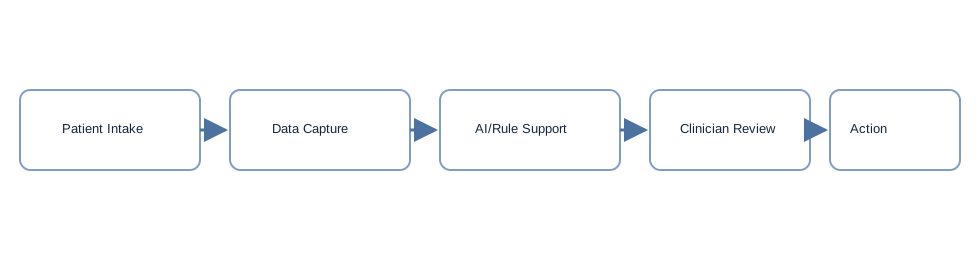
How patient data enters the system and who validates quality.
Foundations
Clinical reality determines adoption. Product decisions should follow how care is actually delivered.
Workbook: 30 minutes
Clinical workflow is the real sequence of people, decisions, handoffs, tools, and time pressures that shape how care actually happens. For founders, this matters because a technically clever product can still fail if it fits badly into daily practice. If the workflow is wrong, adoption is hard, training becomes harder, and safety risks increase even when the software appears to work.
This is why strong medtech teams study the environment before they over-invest in features. They look at who starts the process, who reviews information, what happens during interruptions, what must be documented, and where people already feel overloaded. Products succeed when they reduce friction in that real-world sequence rather than adding a new layer of work.
This page helps learners start with real care work instead of screens. A product may look simple in a diagram but fail when it meets handoffs, interruptions, double documentation, alerts, shift changes, or unclear responsibility.
Use it before writing requirements. Workflow understanding is one of the cheapest ways to prevent building the wrong thing well.
A strong product requirement starts with a real clinical journey: who initiates the workflow, who reviews outputs, when intervention is needed, and what happens when the system fails.
In plain terms, a workflow map tells you where your product enters the day. Does it help with intake, triage, review, intervention, follow-up, or reporting? Does one person use it from start to finish, or does the work move across multiple roles and settings? If you do not understand those transitions, you can easily build a tool that looks helpful in isolation but creates new burden for the people expected to use it.
How patient data enters the system and who validates quality.
Where algorithms and clinicians each contribute to a decision.
How recommendations are executed, documented, and audited.
These stages are simple labels, but they help founders ask better questions. At intake, you are often dealing with data quality and context. During assessment, you are dealing with interpretation and judgment. During action, you are dealing with accountability, timing, documentation, and consequences if something is missed.
Many early product ideas look straightforward until they are placed inside an actual care pathway. A founder may imagine a product that generates an alert when a risk score crosses a threshold. On paper, that sounds useful. In practice, you need to know who sees the alert, how quickly they are expected to respond, what happens if they are busy, what backup path exists if they miss it, and how the response is documented. That is the difference between a feature idea and an operational workflow.
This is also where non-technical founders are often strongest. If you understand the setting, the schedule, the handoffs, the staffing pressures, or the patient experience, you can surface constraints that engineers will not automatically know. That context is not secondary. It is product-defining.
A product can fail even when each screen works correctly. Failure often comes from poor fit around the edges of the workflow: bad timing, unclear ownership, extra data entry, weak escalation, or confusing handoffs. Those issues are easy to miss in product demos because demos usually show an ideal path with no interruptions, no shift changes, and no competing priorities.
Founders should therefore ask not only “Does the feature work?” but also “What happens during a busy day?” “What happens during shift handoff?” and “What happens if the primary user ignores or misses this step?” Those are workflow questions, but they are also product quality questions.
Each of these problems usually feels small at first. Together, they are a major reason digital tools are resisted or quietly abandoned. The safest assumption is that users already have too much to do. Your product has to earn its place in the workflow.
Before approving major product work, ask the team to show one complete care pathway in plain language. Who starts it, what information is needed, what the system does, when a human reviews it, how an action is taken, and how the event is recorded. If the team cannot explain that sequence simply, the product logic is probably still too abstract.
A useful workshop exercise is to map one workflow on a single page and mark four things: where information enters, where decisions happen, where something can fail, and who owns the next action. That simple exercise often exposes missing assumptions faster than a long feature list.
Map one target workflow from trigger to follow-up action and mark where the product changes a human decision, handoff, or documentation step.