Product lead
Translates clinical and business needs into clear priorities and decisions.
Execution
A practical guide for non-developers on who to hire, what roles are essential, and how to choose a stack that can pass from pilot to scale.
Workbook: 40 minutes
Building a medtech team is not mainly about collecting impressive job titles. It is about making sure the essential work is covered by people who can make sound decisions, explain tradeoffs, and own outcomes when things go wrong. A small team can work very well if responsibilities are clear. A larger team can still fail if no one owns the hard decisions.
For non-technical founders, the key question is not "Which programming stack is best?" The better question is "What combination of people and tools will let us build, test, explain, and support this product over time?" That is a simpler and more useful standard because it ties technology choices to actual operating reality.
This page helps non-technical leaders understand that stack choices are ownership choices. A technology stack is not only a list of tools; it determines who can maintain the product, how releases happen, how security is handled, and how future evidence work is supported.
Use it before hiring, contracting, or accepting a build proposal so the team can discuss capability, maintainability, and accountability in plain English.
Founders often start by asking, “Do I need a full-stack developer first?” A better question is, “What outcomes must we achieve in the next 6-12 months?” In medtech, those outcomes usually include: a reliable prototype, evidence of workflow fit, secure handling of sensitive data, and a path to controlled updates.
Once outcomes are clear, team design gets easier. You are not hiring generic developers; you are building capability across product, software, hardware, quality, and operations.
This shift matters because early startups often hire for speed without hiring for responsibility. A developer can build features quickly, but if no one owns testing strategy, documentation, release controls, or risk review, the team may move fast in the wrong direction. Strong team design starts by matching people to critical decisions, not just tasks.
Non-developers often underestimate how valuable their expertise is in technical planning. If you understand clinical workflows, customer operations, reimbursement, compliance, or procurement, you can significantly improve product quality before a single line of code is written.
Your role is to make constraints explicit: what must never fail, what evidence is needed for trust, and what real-world context engineering must design for. Teams that capture this context early usually ship faster and rework less.
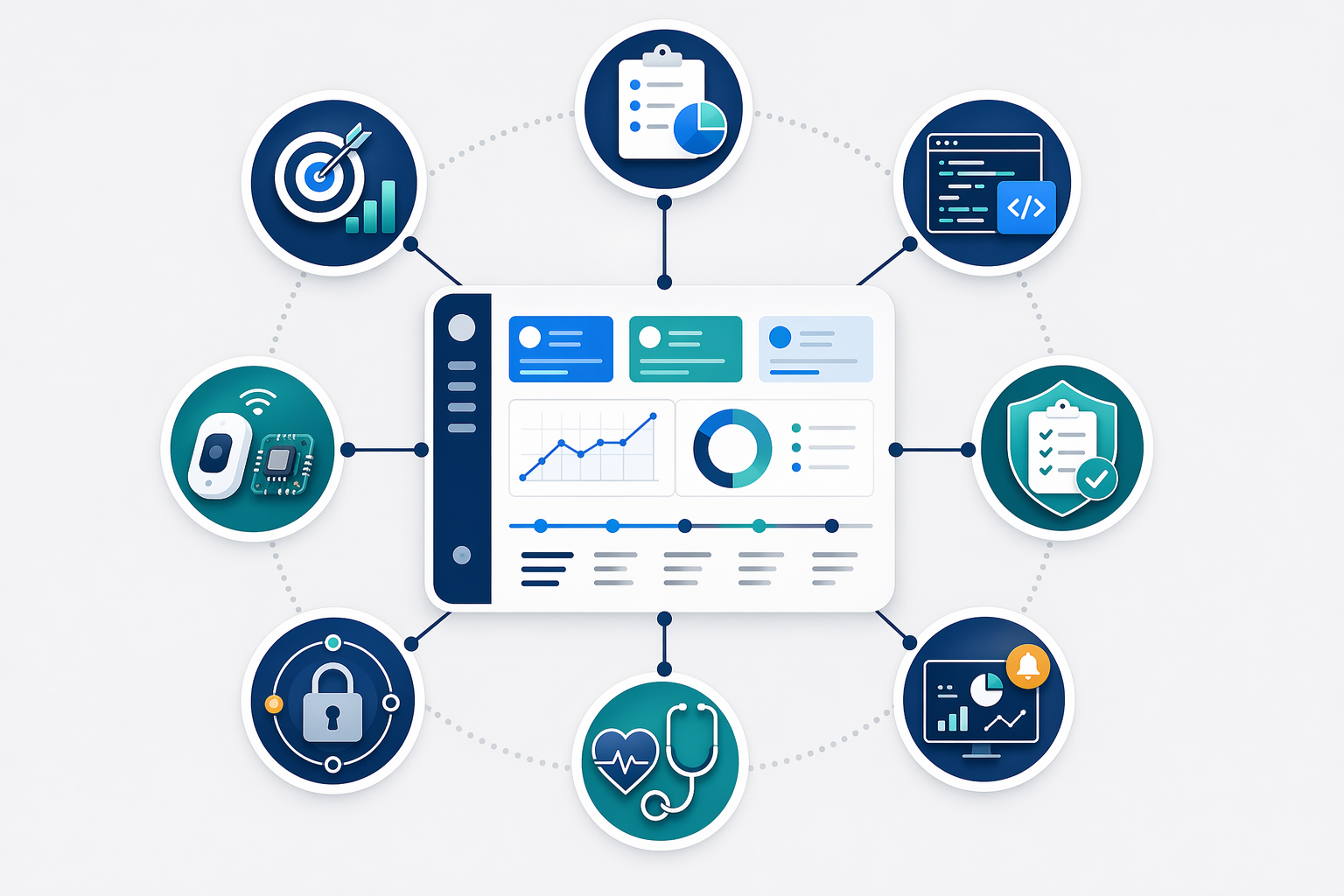
These roles do not always need to be full-time from the beginning. In early stages, one person may cover multiple functions, and some expertise may come from trusted advisors or outside partners. The important point is that the function itself still needs a real owner. If quality, security, or clinical validation is “everyone’s job,” it often becomes nobody’s job.
Translates clinical and business needs into clear priorities and decisions.
Builds backend services, APIs, interfaces, and deployment workflows.
Owns sensors, embedded logic, and device reliability constraints.
Ensures evidence, traceability, and controlled change processes are in place.
Maintains access control, monitoring, incident response, and release safety.
Validates workflow fit, risk points, and usability decisions early.
For a non-technical founder, a useful habit is to ask how these roles work together during one product change. For example, if a new alert feature is added, who defines the requirement, who builds it, who checks the workflow risk, who verifies the release, and who supports it after launch? If the team cannot walk through that sequence clearly, coordination risk is still high.
For many medtech startups, a practical sequence is: product + technical lead first, then one or two software engineers, then targeted quality/regulatory support, then operations/security maturity as usage grows. Hardware-heavy products often add firmware expertise earlier. The goal is to avoid over-hiring before you have validated core workflows, while still covering safety-critical responsibilities.
At each hiring stage, define what decision bottlenecks the new role should remove. This keeps hiring tied to execution progress rather than title-driven growth.
A practical way to think about hiring is to ask what is slowing the team down right now. If decisions are delayed because no one can judge architecture quality, you likely need stronger technical leadership. If releases are slow because documentation and verification are chaotic, you may need quality or delivery discipline more than another feature developer. If customer commitments are growing, operations and support maturity may matter more than adding another builder.
A technology stack is the set of tools and platforms your team uses to build and run the product. In medtech, stack choices should optimize for reliability, maintainability, and evidence generation, not only developer preference.
Plainly put, your stack is the machinery behind the product. It affects how quickly new people can join the team, how safely changes can be made, how easy it is to investigate failures, and how expensive the product is to operate. A stack that looks modern in a pitch deck can still be a poor choice if only one contractor understands it or if it creates unnecessary operational burden.
| Layer | What to decide | Founder questions |
|---|---|---|
| Frontend | Framework for clinician/admin interfaces | Can new team members maintain this quickly? |
| Backend/API | Language/framework for business logic and integrations | How easy is testing, auditing, and observability? |
| Data | Database and storage model | Does this support traceability and retention needs? |
| Cloud/infra | Hosting provider and deployment model | Can we run this securely with our current team size? |
| Device/edge | Firmware stack and update approach | Can we safely update and recover in field conditions? |
Most non-technical founders should bias toward boring, well-supported tools unless there is a strong reason not to. In early stages, simplicity is an asset. The more custom or fragmented the stack becomes, the more you depend on specific individuals and the harder handoff, hiring, testing, and incident response become.
You do not need to debate frameworks line by line. You do need to ask practical questions. Why is this stack a good fit for our team size? How easy is it to hire for? How will we test it? How will we monitor it? What parts will be hardest to replace later? Which pieces are most likely to create vendor lock-in or maintenance burden?
If a technical lead recommends a complex setup, ask what simpler option they rejected and why. That question often reveals whether the team is solving a real product need or just following engineering preference. In medtech, clarity usually beats novelty.
Early teams often rely on fractional QA, security, regulatory, or architecture support. That can be efficient, but only when those experts are attached to real review points. A good advisor is involved in decisions, not just available for occasional reassurance. If they are not reviewing plans, releases, or risks at specific moments, they may not be reducing real execution risk.
Use outside experts to strengthen judgment, unblock specialized work, and improve standards. Do not use them to create the illusion of coverage. If the team cannot explain who makes the final call in each area, the staffing model still needs work.
Strong generalist leaders in medtech are translators. They align specialists around a shared outcome, ask focused questions at each stage, and keep teams grounded in patient, workflow, and operational realities.
That leadership style is especially important when teams use contractors, consultants, or AI-assisted development tools. The more distributed the execution is, the more important it becomes to keep decisions explicit and understandable. Strong founders reduce ambiguity. They do not outsource it.
Create a role map for the next six months and name the human owner for product, clinical, software, hardware, QA/RA, security, operations, and vendor decisions.