See the system
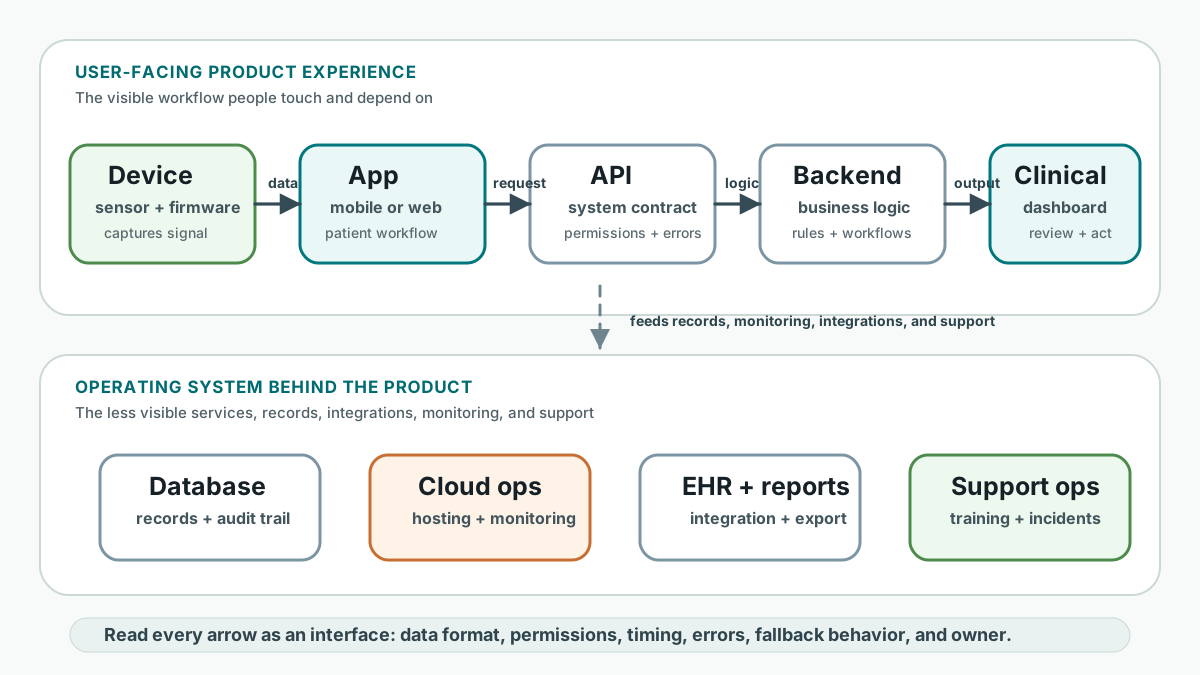
Recognize how apps, APIs, servers, databases, devices, firmware, and cloud services fit together.
Orientation
Use the talk page for the one-hour session, then use this workbook as a deeper reference for medtech software, hardware, cloud, regulation, and operations.
Workbook orientation: 25 minutes
The one-hour talk is only the beginning. Its first outcome is not memorizing standards or choosing a programming language. The first outcome is a shared mental model of the medtech ecosystem: what pieces exist, how they connect, who owns each decision, and what can go wrong when a promising demo becomes a real product.
Recognize how apps, APIs, servers, databases, devices, firmware, and cloud services fit together.
Use practical vocabulary to challenge assumptions about reliability, privacy, security, and workflow fit.
Separate prototype learning from pilot readiness and production operations.
Use this page to separate the live talk from the self-paced workbook. The talk gives people the map; the workbook gives them the detail they can return to when they are planning a build, pilot, or funding conversation.
By the end of this page, a learner should know which pages are required for a quick orientation and which pages become useful later when regulatory, software, hardware, operations, or business questions appear.
This is not a standards memorization course, a coding bootcamp, or legal/regulatory advice. It is a practical orientation for making better early decisions: what to build, what to ask specialists, what evidence matters, and what hidden work appears after the demo.
The deeper pages are there when you need them. During the live session, focus on the system map, the vocabulary, and the questions that reveal whether a product idea is ready for engineering, piloting, or investment.
During the talk, prioritize the short companion page. After the talk, use this sequence to move from shared vocabulary into deeper topic pages.
The order moves from vocabulary to judgment. First learn the building blocks, then the ecosystem, then the execution model. Regulation, quality, security, AI, and operations make more sense once the basic system map is clear.
| Stage | Purpose | Outcome |
|---|---|---|
| Shared language | Explain software, hardware, cloud, data, and AI-assisted building in plain terms. | Participants can follow technical conversations without pretending to be specialists. |
| Ecosystem context | Connect the product to clinical users, IT, procurement, privacy, quality, and regulators. | Teams understand that adoption is more than a feature demo. |
| Build planning | Translate an idea into artifacts builders can use: flows, architecture, APIs, data, tests, deployment, and risks. | Early work becomes concrete enough to estimate, review, and improve. |
| Medtech discipline | Add regulatory, quality, security, validation, hardware, and operations depth. | The roadmap accounts for evidence, support, and long-term change. |
Every boundary between systems is an agreement: format, timing, ownership, errors, versioning, and fallback behavior.
Good product conversations ask what happens when the network drops, the device battery dies, data is stale, or a release goes wrong.
In medtech, confidence has to become records: requirements, tests, validation results, risk controls, and operating logs.
Choose the next pathway based on the decision in front of you: software build, hardware build, regulatory planning, operations, business model, or capstone preparation.