Frontend
The screens people see and touch: mobile app, web app, dashboard, forms, alerts, charts, and settings.
Foundations
A common-language map of the pieces behind modern medtech products: apps, APIs, servers, databases, devices, cloud systems, and AI-assisted prototypes.
Workbook: 35 minutes
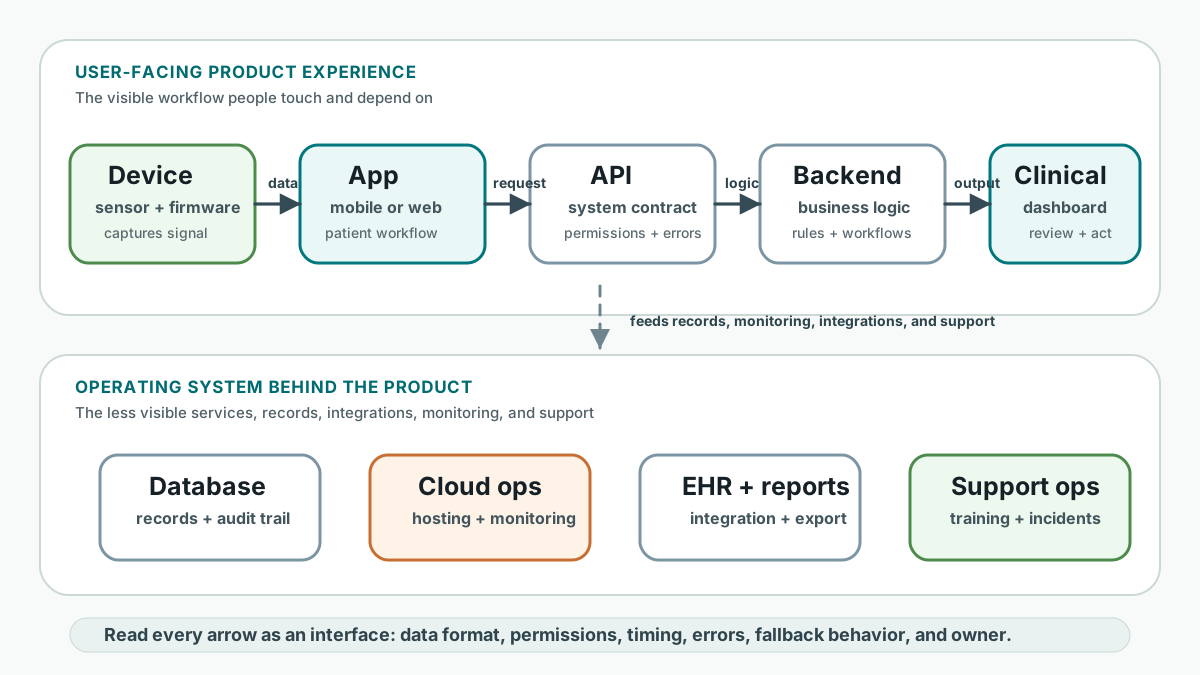
Most medtech products are not just an app, a device, or an AI model. They are connected systems. A patient may use a mobile app, a device may capture data, an API may send that data to a server, a database may store it, and a dashboard may help a clinician decide what to do next.
For a mixed team, the first goal is not deep technical mastery. The first goal is shared language. If everyone can describe what the frontend, backend, API, server, database, firmware, cloud hosting, and deployment each do, the team can scope work more honestly and catch weak assumptions earlier.
This page helps learners name the basic parts of a modern medtech system without pretending to be engineers. The goal is to understand what an app, API, server, database, cloud service, sensor, firmware layer, and AI-assisted prototype each contribute.
Use it before any deeper topic. If the vocabulary here is unclear, later pages on architecture, validation, cybersecurity, and hosting will feel more complicated than they need to.
The screens people see and touch: mobile app, web app, dashboard, forms, alerts, charts, and settings.
The hidden logic that checks permissions, processes data, sends notifications, runs workflows, and connects services.
The structured doorway systems use to talk to each other. Good APIs define what data is allowed, what errors mean, and how versions change.
The computing environment that runs backend code. It may be one simple instance early or a managed cloud service later.
The organized place where records, events, users, device readings, audit trails, and configuration data are stored.
The rented infrastructure for servers, databases, storage, backups, networking, monitoring, and security controls.
A wearable reading usually travels through several steps before anyone acts on it. A sensor captures a signal. Firmware turns that signal into a measurement. The mobile app receives it. An API sends it to a backend service. A database stores it. A dashboard, report, alert, or EHR integration makes it useful to a person.
Each step has a different failure mode. The signal can be noisy, the device can disconnect, the API can reject bad data, the database can store the wrong version, the dashboard can show stale information, or the alert can reach the wrong person. This is why medtech teams talk about systems rather than isolated features.
An app is the user-facing product experience, but the app is rarely the whole product. Many medtech apps depend on backend services, authentication, databases, APIs, notifications, device permissions, and support workflows.
| Model | What it means | Typical medtech question |
|---|---|---|
| Native app | Built specifically for iOS or Android and distributed through app stores. | Do we need deep access to device hardware, sensors, Bluetooth, secure storage, or background activity? |
| Web app | Runs in a browser and is usually easier to update centrally. | Can clinicians or admins use this through secure browsers on managed devices? |
| PWA | A web app that can behave more like an installable app, with some offline and device-like features. | Can we move quickly while still supporting the workflow, permissions, and reliability we need? |
Hardware determines what information can be trusted. Software can clean, analyze, and display data, but it cannot fully rescue a weak signal, poor calibration, unstable battery behavior, or unreliable connection.
Captures a physical signal such as motion, voltage, light absorption, temperature, pressure, or image data.
Low-level software inside the device. It reads sensors, manages power, handles connectivity, and applies updates.
A device or gateway that does some processing near the patient or point of care instead of sending everything to the cloud.
BLE, Wi-Fi, cellular, NFC, or wired links. The choice affects battery life, reliability, security, and support cost.
The process for keeping measurements aligned with trusted references so downstream software can trust the numbers.
Remote updates for firmware or device software. Useful, but risky without signing, staged rollout, rollback, and monitoring.
The same technical building blocks appear in many industries. In medtech, the expectations are higher because the product may affect care decisions, patient trust, sensitive information, and clinical workflow. That does not mean every tool is high risk. It means the team has to be explicit about intended use, users, data handling, failure behavior, and evidence.
| Stage | Main purpose | What must be true |
|---|---|---|
| Prototype | Learn whether the workflow, interface, or idea makes sense. | Limits are clearly stated; no one mistakes a demo for a dependable product. |
| Pilot | Run a narrow real-world trial with defined users, support, privacy, and monitoring expectations. | Data handling, access, logging, support, and failure behavior are planned. |
| Production | Operate repeatedly for real users over time. | Releases, backups, incident response, validation evidence, training, and ownership are controlled. |
Vibe coding and AI-assisted development can be useful for exploration. They can help draft interfaces, generate starter code, build mock data, summarize requirements, and test alternate workflows quickly. That can make early learning much faster.
In medtech, the mistake is treating fast generation as proof of readiness. AI-generated code still needs engineering review, security review, testing, documentation, traceability, deployment discipline, and maintenance ownership. It can accelerate the start of a conversation; it cannot replace responsible product development.
Next read 1) Medtech landscape, then 2) Getting started with engineering, then 3) App development: native vs PWA to connect system vocabulary with real build decisions.
Sketch your product as a chain from user action to data capture, storage, processing, display, and support. Mark every place where data crosses a boundary.