Clinical users
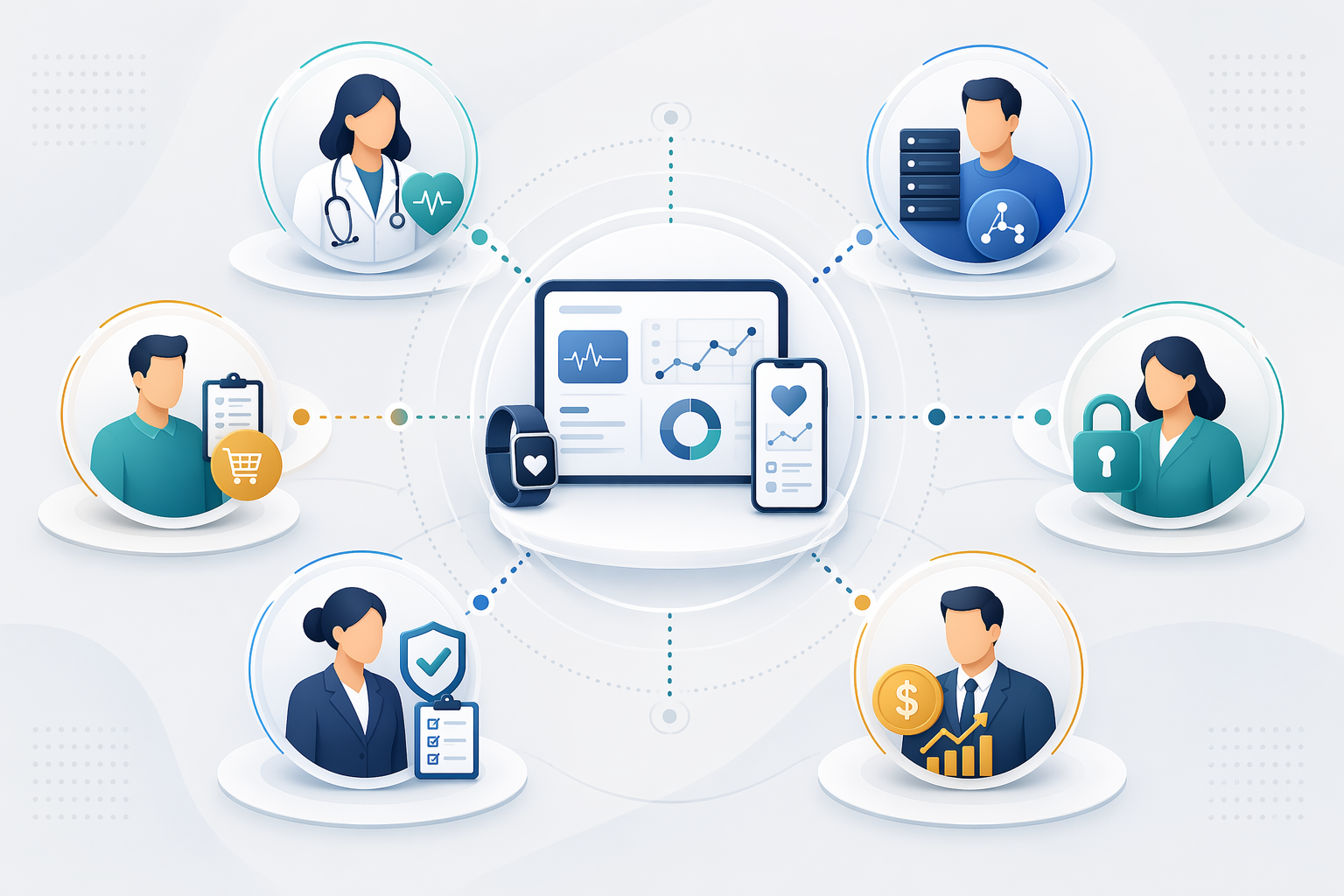
Care teams optimize for patient safety, speed, and cognitive load in real workflows.
Care teams optimize for patient safety, speed, and cognitive load in real workflows.Foundations
Before building software or hardware, understand who influences adoption, risk, reimbursement, and long-term support in Canada and Alberta.
Workbook: 35 minutes
The medtech ecosystem is a network, not a single buyer. Clinical teams care about patient safety and workflow fit. Health system operations teams care about interoperability, support load, and downtime risk. Security and privacy teams care about access control, data residency, and auditability. Regulators and quality leaders care about evidence, traceability, and safe change management.
Founders often meet these groups one at a time and assume each conversation is separate. In practice, their concerns stack. A feature that saves clinician time may still fail if the privacy review is unclear, the support model is expensive, the integration path is custom, or the procurement case cannot show credible value.
Use the stakeholder map as a sequence of trust questions. Before asking for a pilot, name what each group needs to see, who owns the answer, and what artifact proves the answer: a workflow map, data flow diagram, risk file, support plan, security summary, evidence protocol, or total cost of ownership model.
The goal is not to satisfy everyone with a large document at the beginning. The goal is to learn which approval path is real, which risks must be reduced first, and which promises should not be made until the product, evidence, and operating model can support them.
Care teams optimize for patient safety, speed, and cognitive load in real workflows.
Care teams optimize for patient safety, speed, and cognitive load in real workflows.Patients and caregivers need clear instructions, accessible design, privacy confidence, and realistic support when something goes wrong.
Patients and caregivers need clear instructions, accessible design, privacy confidence, and realistic support when something goes wrong.IT, biomed, and procurement teams optimize for uptime, support cost, and integration burden.
IT, biomed, and procurement teams optimize for uptime, support cost, and integration burden.Privacy and security teams look for data minimization, access control, vendor risk, incident response, and auditability.
Privacy and security teams look for data minimization, access control, vendor risk, incident response, and auditability.QA/RA leaders optimize for evidence, traceability, and controlled change management.
QA/RA leaders optimize for evidence, traceability, and controlled change management.Finance and procurement teams ask whether value, reimbursement, implementation effort, and total cost of ownership make adoption realistic.
Finance and procurement teams ask whether value, reimbursement, implementation effort, and total cost of ownership make adoption realistic.This page helps learners see that medtech adoption is a system decision, not just a product decision. A useful feature still has to fit clinical work, privacy review, security review, procurement, quality expectations, support capacity, and cost constraints.
Use it to widen the conversation before the team locks onto a single demo, feature list, or technical architecture.
A practical landscape review should end with decisions, not only awareness. After mapping stakeholders, decide which user group must be interviewed next, which approval requirement could block a pilot, which technical assumption needs evidence, and which cost or support burden must be priced into the business model.
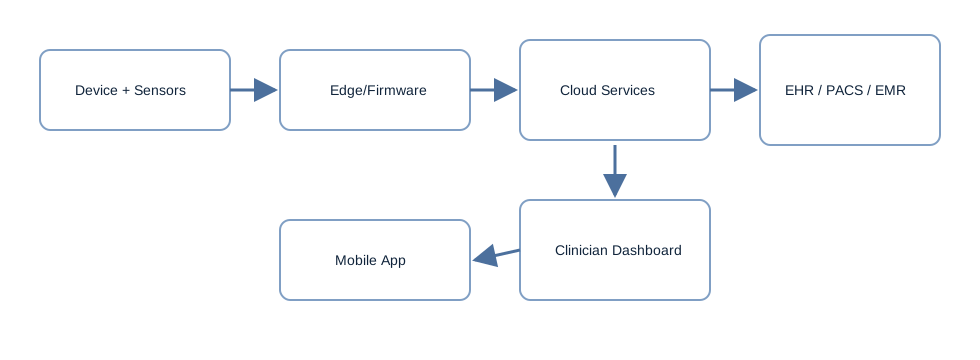
Medtech products range from software-only diagnostics to connected devices. Most teams eventually run a blended model that combines device firmware, cloud services, clinical interfaces, and support operations. In Alberta settings, teams often start with pilot deployments in a narrow workflow and then scale once integration, privacy, and service operations are proven.
In plain terms, software tells you what to do with information, hardware tells you what information you can trust, and cloud services keep that system available across sites. If any one piece is weak, clinical teams lose confidence quickly.
A product usually does not move from good idea to broad use in one step. It moves through a chain of trust: clinical usefulness, workflow fit, privacy review, security review, procurement, implementation, training, support, evidence generation, and renewal. A weak link can slow adoption even when the core technology works.
This is why early founder conversations should include more than feature ideas. Ask who must approve the pilot, who must support the product, who pays for the work, who carries risk if something fails, and what evidence would make the next decision easier.
A landscape map becomes useful when it turns into concrete planning artifacts. The examples below show how a founder might connect stakeholders, timeline, theory of change, and goals for an Alberta referral-triage pilot.
Use a Gantt-style schedule to make sequence, dependencies, and decision gates visible. The example below keeps the timeline high level; the goal is to expose who owns each stage and what must happen before the pilot scales.
| Workstream | May | June | July | Owner | Gate or evidence |
|---|---|---|---|---|---|
| Intended use and claim boundary | Draft and review | Update after risk review | Confirm before scale decision | Product + RA | Approved claim boundary |
| Workflow and stakeholder mapping | Clinic shadowing and referral map | Training plan | Adoption review | Clinical lead | Critical workflow risks named |
| Privacy and data package | Data map and PIA inputs | Privacy review support | Retention and access check | Privacy lead | Ready for custodian review |
| Prototype build and pilot launch | Test-data prototype | Pilot-ready release | Support and monitoring | Engineering | Go/no-go design review |
| Evidence and scale decision | Define metrics | Collect baseline and usage data | Decision memo | Founder team | Proceed, revise, or stop |
A logic model connects product activity to expected outcomes. It helps the team avoid a common mistake: measuring app usage without explaining why usage should lead to clinical, operational, or business value.
| Inputs | Activities | Outputs | Short-term outcomes | Long-term outcomes |
|---|---|---|---|---|
| Clinical champions, clinic staff, privacy advisor, test environment, app, dashboard, hosting budget | Map referral workflow, define data fields, train users, run pilot, monitor support tickets and completeness | Pilot protocol, trained users, active intake forms, dashboard reviews, support log, data map | Fewer incomplete referrals, faster triage review, clearer escalation, visible support burden | Repeatable deployment model, stronger evidence package, procurement-ready business case |
Theory of change: If clinics use structured intake and referral completeness checks, then staff can submit more complete referrals because missing data is caught before specialist review. This should reduce back-and-forth communication, shorten time to triage, and produce evidence for a broader integration decision.
SMART goals turn broad ambition into reviewable commitments. For medtech teams, the best goals usually include an owner, evidence artifact, and date.
| Goal | Specific | Measure | Owner | Deadline |
|---|---|---|---|---|
| Validate workflow fit | Run five moderated referral-triage workflow reviews with target Alberta users. | At least 80 percent of critical tasks completed without facilitator rescue. | Clinical lead | June 30, 2026 |
| Prepare privacy package | Complete data map, PIA inputs, and vendor/subprocessor list. | Privacy reviewer confirms package is ready for formal review. | Privacy lead | June 21, 2026 |
| Prove support model | Track support tickets, incidents, uptime, and onboarding effort for the first pilot month. | Weekly support report completed with owner and trend for each issue. | Operations lead | July 31, 2026 |
Before this page, read Software + hardware basics so the app, API, server, database, device, and cloud terms are familiar. Next read Getting started with engineering to turn that ecosystem view into concrete build decisions.
Create a stakeholder map for the first pilot and name what each stakeholder needs to trust before saying yes. Then translate the ecosystem view into one schedule, one logic model, and three SMART goals.