Founder-led early team
Build a small internal team and keep architecture choices simple while validating the clinical workflow.
Getting Started
A plain-language starting point for founders and non-engineers deciding how to begin product development.
Workbook: 40 minutes
Getting started in medtech engineering does not mean choosing a programming language on day one. It means deciding what problem you are solving, which people are affected, what level of reliability is required, and what kind of team can build and support the product responsibly. For non-technical founders, the first job is not writing code. The first job is reducing confusion.
A useful mental model is this: you are not only building screens or a device. You are building a service that has to keep working when real people depend on it. That service usually includes user interfaces, business logic, data storage, security controls, alerts, reports, support processes, and update procedures. If hardware is involved, it also includes sensors, firmware, connectivity, charging, maintenance, and replacement planning.
This page helps teams turn an idea into something builders can understand, challenge, estimate, and improve. A vague request like build an app becomes more useful when it includes users, workflows, data, constraints, risks, outputs, and evidence expectations.
Use it when a founder, clinician, researcher, or operator is ready to move from conversation into a practical build brief.
Most medtech teams are not building only an app. They are building a service around care: data capture, processing, user interfaces, decision support, security controls, and support workflows. Understanding this early helps you avoid under-scoping the project.
For non-experts, the goal is not to code everything yourself. The goal is to make strong decisions about priorities, team structure, and risk so specialists can execute effectively.
In practice, that means asking plain questions early. What has to work every time? What can fail safely? Who reviews outputs before action is taken? What happens if the internet drops, a device battery dies, or a software update introduces a bug? Founders who ask these questions early tend to make better product and hiring decisions because they see the system as a whole, not as a collection of features.
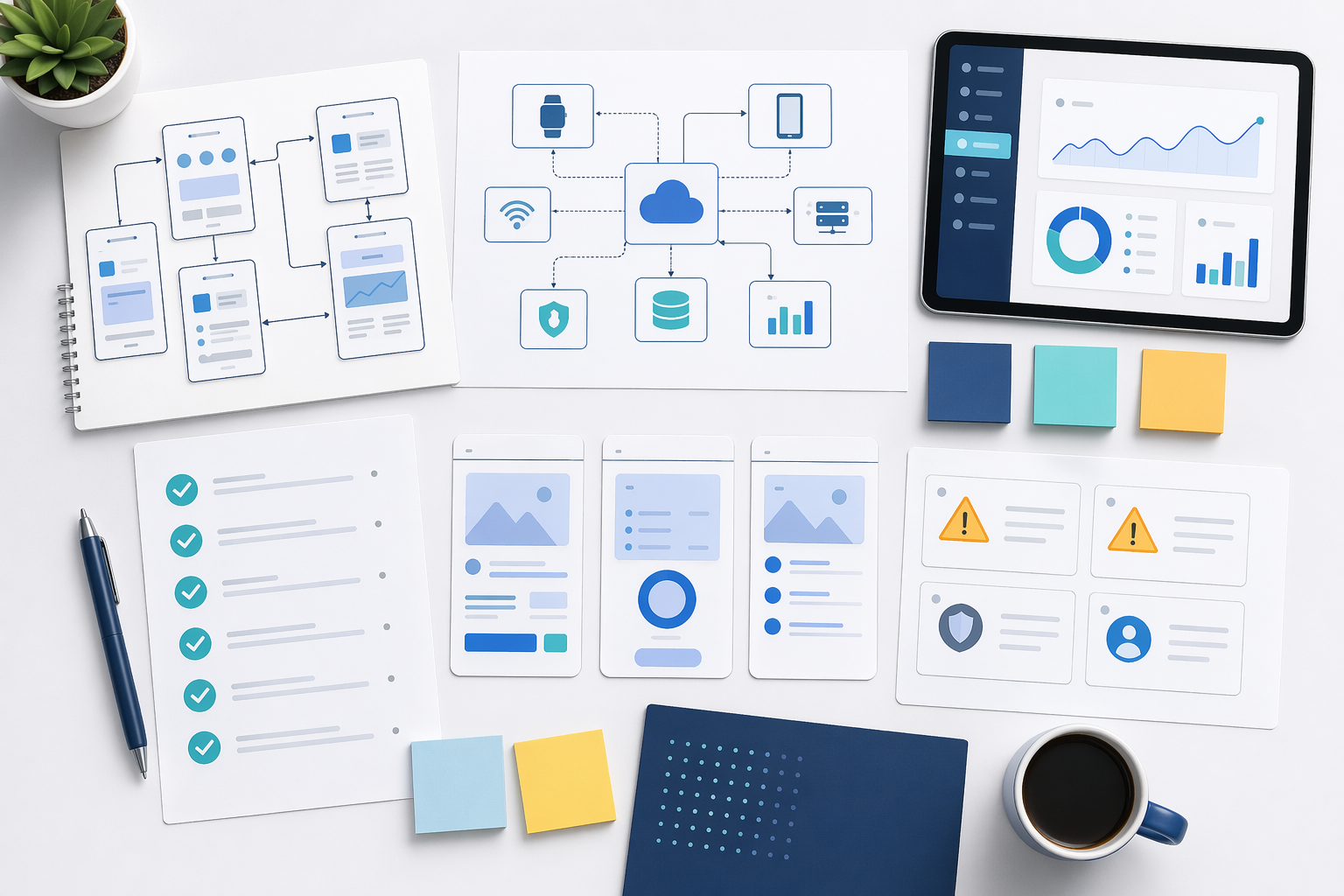
Before asking someone to build, write one plain-language page that explains the first workflow well enough for a builder, advisor, or stakeholder to challenge it. This does not need to be perfect. It needs to be concrete.
Use the builder brief worksheet to capture the workflow, data path, failure behavior, and builder deliverables before implementation starts.
A strong early engineering conversation produces visible artifacts, not only a feature list. These artifacts let technical and non-technical participants point to the same assumptions and improve them together.
| Artifact | What it answers | Founder check |
|---|---|---|
| Screen flow | What the user sees from start to finish. | Can a clinician, patient, or admin understand the workflow without a verbal demo? |
| Architecture sketch | Where apps, APIs, servers, databases, devices, and cloud services fit. | Can the team explain what happens if one part is offline? |
| API contract | How systems exchange data, errors, permissions, and versions. | Is the agreement specific enough that two builders could work independently? |
| Data model | What records exist, how they relate, and what must be audited. | Can the team explain where sensitive data lives and how long it is kept? |
| Test plan | How the team proves the product behaves as expected. | Which critical risks are tested automatically, manually, or through user validation? |
| Deployment plan | How software moves from development to pilot or production. | Who approves releases, monitors them, and rolls back if something fails? |
| Risk list | What could harm users, operations, privacy, security, or trust. | Are the highest-risk assumptions named before the team builds around them? |
A prototype is mainly for learning. It helps you test whether users understand the workflow, whether the product solves a real problem, and whether people care enough to keep using it. A prototype can be rough as long as everyone is honest about its limits.
A pilot is different. A pilot is not just a prettier prototype. It is an early real-world operating version. At that stage, you need clearer ownership, better logging, stronger security, defined support steps, and a plan for fixing problems quickly. Production adds another layer again: repeatability, monitoring, documentation, controlled releases, training, and reliable support over time.
Many teams get into trouble by building a strong demo and then assuming they are close to launch. In medtech, the gap between a convincing demo and a dependable product can still be large. Naming the stage accurately helps you budget and plan honestly.
There is no single correct way to start. The right path depends on your budget, risk profile, internal expertise, and how quickly you need to test the core workflow. What matters most is choosing a build model that matches your ability to supervise quality.
Build a small internal team and keep architecture choices simple while validating the clinical workflow.
Use external specialists to accelerate progress where in-house skills are missing.
Combine contractors with a strong technical advisor to control quality and reduce dependency risk.
A founder-led team usually works best when you can recruit at least one strong technical lead early and keep the initial scope narrow. A consultant-assisted build can work well when speed matters and you already know the workflow well, but only if you define deliverables, documentation, and handoff expectations clearly. A contractor plus advisor model can be efficient for early work if the advisor is active, not symbolic, and is willing to review architecture, code quality, and release decisions in detail.
Consultants and contractors can move fast, but only if scope and ownership are clear. Define exactly what they are responsible for: architecture, implementation, testing, documentation, and handoff. Without this clarity, teams often deliver features but not maintainable systems.
Ask every external partner how they will transfer knowledge back to your team. In medtech, long-term maintainability is as important as speed to first demo.
Ask simple questions in plain language. Who owns the system design? Who can explain how data moves through the product? Who writes tests? Who decides whether a release is safe enough to ship? Who can fix a production issue at short notice? If the answers are vague, your delivery risk is high even if progress looks fast on the surface.
It is also reasonable to ask external builders to explain tradeoffs without jargon. A good partner should be able to tell you why they chose a certain stack, what could break, what is hard to change later, and where they are making assumptions. If they cannot explain it simply, they may not understand it well enough themselves.
Your leverage is not pretending to be an engineer. Your leverage is setting priorities, clarifying constraints, and making sure the team does not build the wrong thing efficiently. You should be able to explain the one core workflow the product must support, the users involved, the highest-risk failure, and the minimum evidence you need before expanding scope.
A practical founder habit is to ask for visible artifacts, not vague updates. Ask for screen flows, architecture sketches, test plans, risk lists, and weekly demos tied to acceptance criteria. This keeps the conversation grounded in observable work rather than optimism. It also makes it easier to spot when a team is building a polished demo instead of a dependable product.
Treat this checklist as a starting discipline, not as paperwork. Each item reduces a common source of startup waste: unclear scope, fragile architecture, rushed delivery, and missing accountability.
Complete a one-page builder brief before asking for estimates. Include the workflow, users, data inputs, outputs, constraints, and the question the prototype or pilot must answer.