Collection
Define legal authority, minimum dataset, and how consent or notification is captured in the workflow.
Foundations
How federal and provincial health information rules shape architecture, vendors, and what you need before a pilot.
Workbook: 35 minutes
Founders often treat privacy and regulatory context as a late-stage legal review. In practice, these factors influence architecture from day one: where data is stored, how access is controlled, which vendors are acceptable, and what evidence your team must maintain.
A balanced Canadian approach usually means aligning with federal expectations while honoring provincial healthcare and privacy realities. In Alberta, the Health Information Act (HIA) and custodian practice standards shape what you can collect, who may access it, and what must be documented before you touch real patient data.
This page is not legal advice. Use it to ask better questions of privacy counsel, custodians, and your own technical leads.
This page helps learners understand the local deployment context before data starts moving. In Alberta, health information roles, privacy impact assessment inputs, custodian expectations, vendor responsibilities, data residency, and breach readiness can shape the architecture from the start.
Use it before proposing a pilot that touches identifiable health information or depends on a health-system partner.
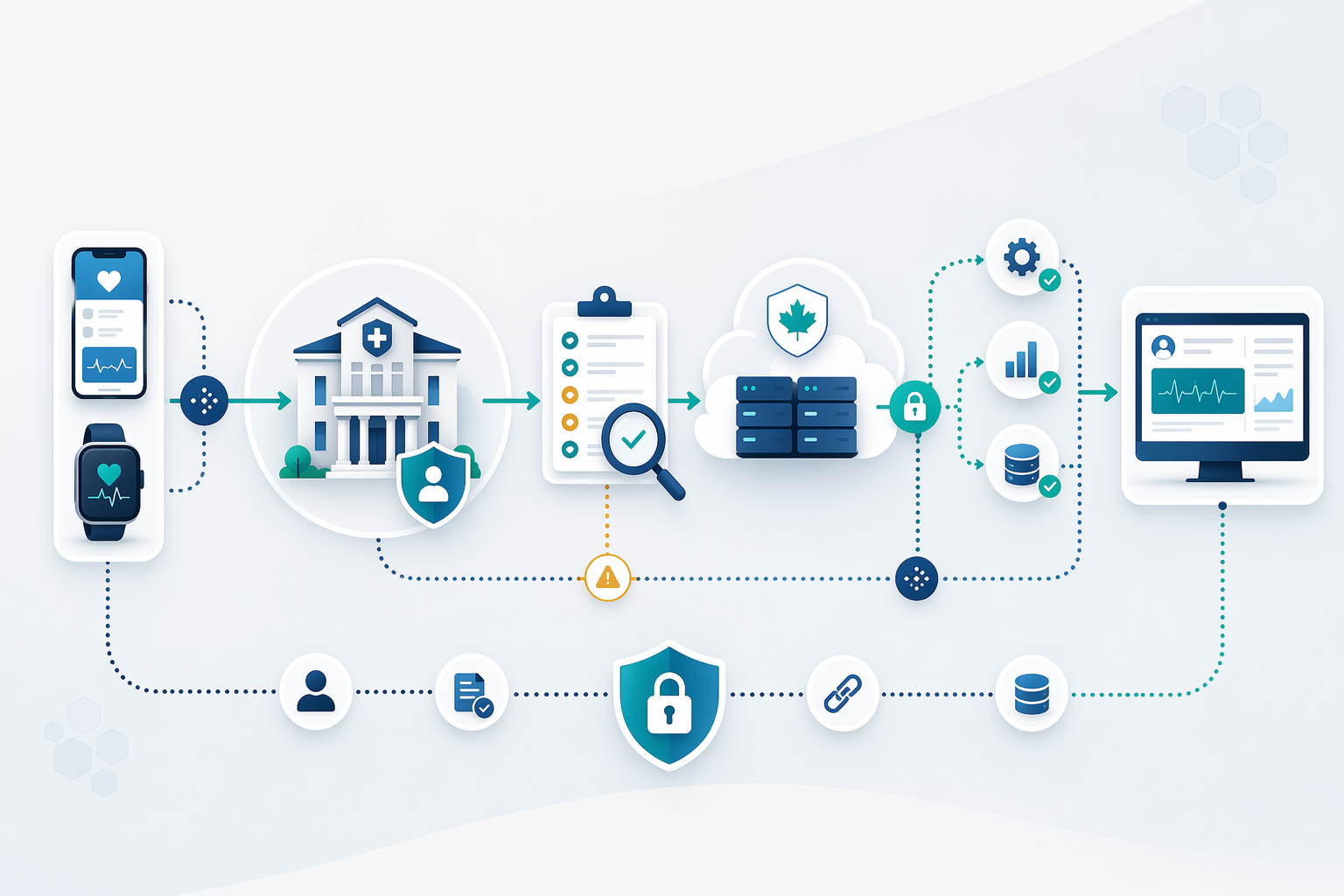
Under Alberta’s framework, custodians (for example physicians, Alberta Health Services units, or other designated providers) hold health information in trust for patients. They must follow rules for collection, use, disclosure, safeguarding, and retention.
Affiliates are authorized to act on behalf of a custodian for limited purposes. If your pilot runs inside a custodian’s environment, your agreements should spell out whether you act as an affiliate, subcontractor, or separate custodian—and who is accountable for each processing step.
When a vendor hosts or processes identifiable health information for a custodian, contracts typically require flow-down of HIA obligations: permitted purposes, minimum necessary access, subprocessors, audit support, breach cooperation, and return or destruction at end of service.
Alberta custodians often require a privacy impact assessment (or equivalent risk assessment) before new systems handle health information. Treat the following as “expect a PIA conversation” triggers, not an exhaustive legal list:
Use the curriculum PIA worksheet template to prepare inputs before you meet the custodian’s privacy office.
Custodians must detect, contain, and report unauthorized access or disclosure according to HIA and Office of the Information and Privacy Commissioner of Alberta (OIPC) expectations. Founders should prepare before an incident:
Link operational logging to your incident response runbook template and cybersecurity pages.
Even when a cloud provider secures the infrastructure, your team remains responsible for configuration, identity, encryption choices, and application-layer controls. Contracts with custodians should cover:
Align procurement with the shared responsibility model described in glossary: shared responsibility.
Define legal authority, minimum dataset, and how consent or notification is captured in the workflow.
Map each feature to a permitted purpose; separate research or AI training flows from care delivery where required.
Align schedules with custodian policy; automate secure deletion in backups and replicas.
If data leaves Canada, document rationale, safeguards, and whether de-identification is appropriate.
Clarify where sensitive data is stored, processed, and backed up. Document why each location is acceptable to the custodian.
Cloud providers secure infrastructure, but your team still owns identity, access, configuration, and incident response.
Maintain logs, change records, and traceability to show decisions are intentional and controlled.
Curriculum page last reviewed: 2026-04-22.
Summaries are for learning only; provincial health information law is specific to role and context—consult qualified counsel.
Draft a data map that names data categories, systems, custodians or accountable organizations, subprocessors, storage locations, and breach contacts.