Scope control
Clear inputs prevent uncontrolled feature growth and cost surprises.
Regulatory
Design controls turn product ideas into testable requirements and objective evidence.
Workbook: 30 minutes
Design controls are the structured way medtech teams turn an idea into something testable, reviewable, and defensible. They are not mainly about slowing teams down. They are about making sure the product is being built on purpose. In practice, design controls help a team explain what problem it is solving, what the product is supposed to do, how that intent became requirements, and what evidence shows the result is acceptable.
For founders, this is one of the clearest examples of disciplined building. Without design controls, teams often jump from broad intentions to implementation details too quickly. That makes scope harder to control, testing harder to organize, and change harder to assess later.
This page helps learners understand how an idea becomes controlled evidence. Design controls connect user needs to requirements, design outputs, verification, validation, risk controls, and change decisions.
Use it when the team needs to stop treating requirements, tests, and risk files as separate documents and start treating them as one evidence chain.
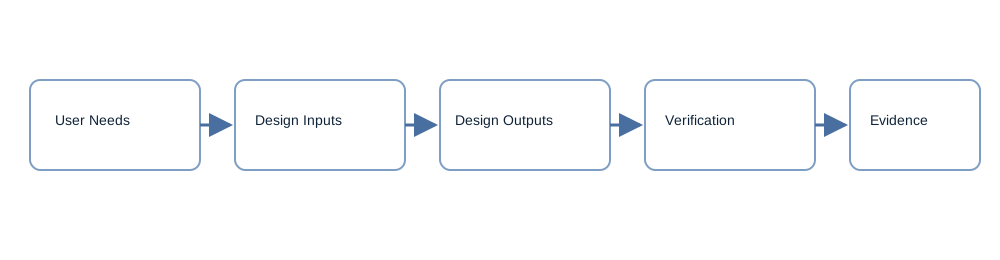
Start with user needs, convert them into design inputs, produce design outputs, verify outputs against inputs, and validate with intended users in intended environments.
That chain matters because each step answers a different question. User needs describe the real problem. Design inputs make that problem specific enough to build against. Design outputs are the actual product artifacts. Verification checks whether those outputs meet the inputs. Validation checks whether the result works for real users in the real setting. When the chain is visible, teams are less likely to build features that sound useful but are weakly defined or poorly supported.
Design controls are useful even before formal submission work is front and center. They improve day-to-day decision quality. They help founders know whether the team is working from clear requirements or from shifting interpretation. They also make it much easier to explain why a feature exists, what problem it addresses, and what evidence supports it.
Clear inputs prevent uncontrolled feature growth and cost surprises.
Traceability means each claim has supporting verification evidence.
Updates can be assessed quickly because dependencies are documented.
Traceability is often described as a documentation exercise, but its real value is operational. It helps the team understand what depends on what. If a requirement changes, which tests are affected? If a risk control is updated, what evidence needs review? If a defect appears in a fielded feature, which user need and design input does it connect to? Those answers become much faster when the chain is explicit.
For a founder, this is especially useful during change discussions. A team with good traceability can explain the impact of an update more clearly. A team without it may still be able to ship, but it will have a harder time proving what changed and what else might now be at risk.
Ask to see one example traced all the way through. Start with one important user need, then ask what design input captures it, what part of the product implements it, what tests verify it, and what evidence supports validation. If the team can walk through one example clearly, that is a good sign. If not, the design-control process may still be too loose.
This is also a strong way to pressure-test vague product language. If a statement cannot be turned into a concrete requirement and test, it may still be too broad to guide development well.
Curriculum page last reviewed: 2026-04-22.
Summaries are for learning only; design controls must meet applicable jurisdictional requirements.
Take one important user need and trace it to a requirement, design output, verification test, validation activity, and risk control.