What this page helps you decide
This page helps learners see that hardware data quality begins before software sees a number. Sensor choice, placement, analog front end design, filtering, calibration, sampling, motion artifact, EMI, and environmental conditions all shape downstream reliability.
Use it before assuming that an algorithm, dashboard, or AI model can correct weak physical measurements after the fact.
What founders need to know
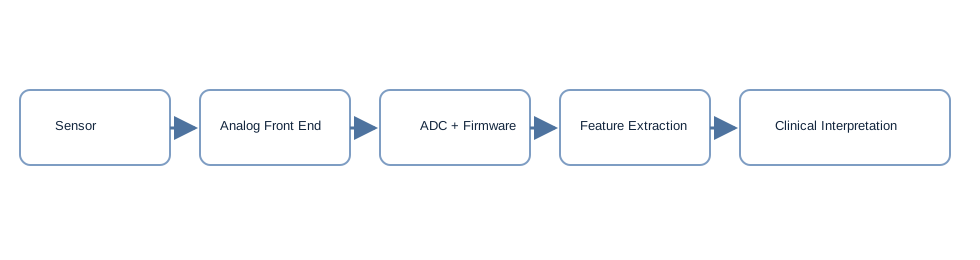
A signal chain is everything between the physical phenomenon you care about (for example ECG voltage, SpO₂ light absorption, or temperature) and the numbers your algorithms consume. Noise, offset, drift, and aliasing introduced here cannot always be fixed in software. For AI-enabled devices, dirty inputs create label noise and unstable models—document sensor limits in your data card and risk file.
Sensor selection
Compare datasheets on range, resolution, noise density, bias stability, power, and operating temperature—not only price. Ask:
- Does the sensor cover the full physiological range you claim?
- How does accuracy degrade at skin temperature extremes or motion?
- What is the long-term drift spec, and how often must users or clinicians recalibrate?
- Are there known cross-sensitivities (for example motion artifact on PPG)?
Front-end and sampling
Analog front ends (amplification, filtering, anti-aliasing) set the noise floor before analog-to-digital conversion. Sampling rate and bit depth must satisfy Nyquist for the bandwidth you need—undersampling causes aliasing that looks like mysterious algorithm failure. Work with hardware leads to capture filter topology, gain stages, and ADC reference stability in design outputs so verification can repeat measurements.
Calibration and traceability
Define who performs calibration (factory only, field, or user), with what reference equipment, and how often. Maintain traceability to standards where applicable. If calibration drifts in the field, your SaMD may breach performance claims—tie calibration intervals to risk controls in ISO 14971.
EMI, grounding, and environmental qualification
Medical environments include RF interference, defibrillation pulses, and consumer chargers. Plan EMC testing early. Environmental qualification should reflect real deployment: temperature, humidity, shock, and wear for home versus ambulance use.
Linking to software and ML risk
Document assumed signal quality bands for each algorithm. When inputs fall outside those bands, software should degrade gracefully (for example prompt for re-placement, not silent wrong output). Map these assumptions to verification tests and post-market monitoring metrics.
What matters most (summary)
- Sensor selection for sensitivity, stability, and expected use environment.
- Calibration process and drift behavior over product life.
- Noise filtering assumptions and their impact on downstream algorithms.
Practical next step
List the environmental and user conditions that could degrade your sensor output, then tie each one to a design control or verification test.
- Template or worksheet: data card template.
- Glossary terms: sensor, calibration, signal-to-noise ratio.
- Pathway links: Edge and firmware, Risk engineering.