In plain language
Cybersecurity work does not end when the product launches. Postmarket operations are the ongoing practices that help a team monitor new vulnerabilities, assess real-world risk, plan updates, communicate with customers, and keep the product trustworthy over time. In medtech, that continuity matters because products often stay in use for long periods and may operate in complex environments with real consequences if they are disrupted.
For founders, the main shift is this: cybersecurity is not just a project milestone. It is a continuing operating responsibility. Once the product is in the field, the team has to be ready to respond to newly disclosed vulnerabilities, third-party component issues, and changing threat conditions without losing control.
What this page helps you decide
This page helps teams understand that cybersecurity does not end at launch. Vulnerabilities, dependency updates, support access, customer communication, incident handling, and patch decisions become part of the operating model.
Use it before scaling a product that depends on cloud services, mobile apps, firmware, third-party libraries, or customer IT environments.
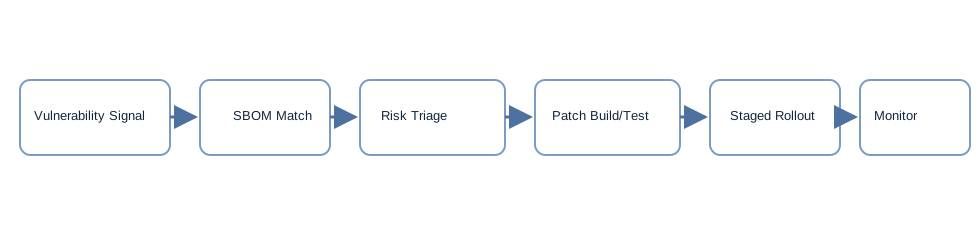
Operational model
Postmarket security operations combine visibility, prioritization, and action. The team needs to know what components are in the product, what new vulnerabilities affect them, which issues matter in the actual deployment context, and how updates will be delivered safely.
- Maintain current SBOMs for software and firmware components.
- Track disclosed vulnerabilities and assess exploitability in your context.
- Prioritize patches with risk-based deployment strategy.
- Communicate transparently with customers and regulators when required.
This is where disciplined asset knowledge becomes extremely valuable. A team that knows what it shipped can respond much faster than a team that has to rediscover its dependencies during an incident.
Operating cadence
Security operations need a rhythm before there is a crisis. Define how often the team reviews vulnerabilities, updates the SBOM, tests backups or rollback, runs tabletop exercises, and reports unresolved risk to leadership. The cadence can be lightweight early, but it should be explicit.
Why founders should care
Postmarket security operations affect trust, customer relationships, and operational cost. A company that responds slowly or opaquely to security issues may create more damage than the vulnerability itself. By contrast, a company with a clear process can assess the issue, explain the risk, prioritize the response, and communicate responsibly.
This also connects directly to planning. If your product depends on complex third-party software, device fleets, or multiple deployment environments, your patch and communication burden may be much higher than you first expect. That burden belongs in the operating model, not as an afterthought.
Common misconception
A common misconception is that every disclosed vulnerability requires immediate panic. In reality, what matters is exploitability and impact in your specific product context. Some issues require urgent action. Others require careful tracking and planned remediation. A mature team can distinguish between them without becoming complacent.
Another misconception is that having an SBOM is enough by itself. An SBOM is useful because it supports action. If the organization does not review it, update it, and use it during assessment and response, it becomes a static artifact rather than a security tool.
Concrete advice for non-technical founders
Ask the team how a newly disclosed vulnerability would be handled from start to finish. Who would assess it? How would they determine whether your product is affected? How would severity be judged? Who would approve a patch plan? How would customers be informed if needed? Those are leadership questions, not just technical ones.
A practical near-term goal is to define patch response expectations by severity and product context. That creates a shared operating rule before the next real issue arrives.
Official references
Curriculum page last reviewed: 2026-04-22.
Summaries are for learning only; coordinate postmarket cyber programs with regulatory and legal counsel.
Practical next step
Create a vulnerability response runbook that names intake, triage, owner, customer communication, patch decision, verification, and release steps.
- Template or worksheet: incident response runbook template.
- Glossary terms: SBOM, coordinated vulnerability disclosure, postmarket surveillance.
- Pathway links: Hardware pathway, Operations.