In plain language
Deployment is the practical act of putting your product into a real operating environment and keeping it working over time. Observability is how you understand what the system is doing after it is live. Together, these topics sit at the boundary between building and operating. They matter because many products fail not when they are first built, but when they begin to face real usage, real updates, and real incidents.
For non-technical founders, this is where the difference between a prototype and a dependable product becomes obvious. A prototype only has to impress a few people for a short time. A deployed product has to survive routine use, unexpected load, outages, configuration mistakes, and human error. Observability is what allows the team to notice, explain, and recover from those problems before they grow into serious workflow disruptions.
What this page helps you decide
This page helps learners understand what it takes to run a product after it is built. Deployment, rollback, logs, metrics, traces, alerts, incidents, and support ownership are what make a product observable and recoverable.
Use it when moving from local demo to pilot, or from pilot to production, because the operational bar changes sharply at each stage.
Deployment model choices
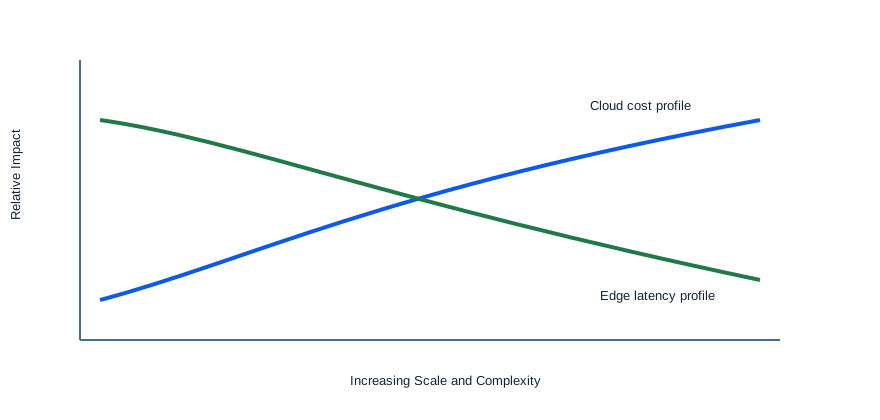
Deployment means deciding where your system actually runs and how it stays available. A typical stack includes application servers, managed databases, object storage, backups, and monitoring tools. In founder terms, this is the difference between a system that works in demos and a system that survives real users, updates, and incidents.
Deployment choices also affect how fast the team can release updates, how easily issues can be rolled back, and how much operational burden the product creates. If the environment is too fragile or too complicated, even a small change can become risky. That is why deployment planning should happen alongside product planning, not after it.
Observability essentials
Observability is your ability to answer three questions quickly: what failed, who is affected, and what to do next. Without this, small bugs become clinical workflow disruptions.
- Define service-level objectives by clinical workflow criticality.
- Track logs, metrics, and traces across device and cloud layers.
- Establish escalation ownership and on-call boundaries.
In plain language, observability is how the team avoids guessing. Good logs show what happened. Good metrics show whether the system is healthy. Good alerting shows when human attention is required. Together they reduce time lost during incidents and make it easier to decide whether a problem is minor, widespread, or safety-relevant.
What mature operations look like
Mature operations do not mean building a giant DevOps organization immediately. They mean having clear basics in place: who can deploy, how releases are reviewed, how problems are detected, how incidents are escalated, and how the team learns from failures. Even a small company can operate well if these responsibilities are explicit.
A founder-friendly way to judge operational maturity is to ask what would happen if a release caused a serious issue at 6 a.m. Who would know? How would they know? What information would they have? How would they decide whether to roll back, patch, or pause? If those answers are unclear, deployment readiness is weaker than it looks.
Common misconception
Many teams assume secure hosting alone solves operational risk. In reality, provider security features are only one layer. Your own access controls, release practices, alerting quality, and incident response discipline determine day-to-day reliability.
Another misconception is that observability is optional until scale arrives. In reality, early observability is often what makes scale survivable later. Teams that start with no meaningful logging, no alert ownership, and no clear incident process usually pay for that omission during the first serious customer-facing problem.
Concrete advice for non-technical founders
Ask the team to explain deployment and incident handling in business language. How often do we deploy? Who approves releases? How do we know if something broke? How quickly can we respond? Which failures matter most to users? These questions turn operations into something reviewable rather than mysterious.
A useful operating drill is to run a simple tabletop exercise before launch. Pick one scenario, such as a service outage, failed update, or missing data feed, and walk through what the team would do. The goal is not perfection. The goal is to expose confusion before the real incident arrives.
Practical next step
Choose five operational metrics for the first pilot and assign an alert owner, review cadence, and response path for each one.
- Template or worksheet: incident response runbook template.
- Glossary terms: deployment, observability, SLO.
- Pathway links: Hosting providers, Postmarket cybersecurity.