Why this matters in medtech
Patients and clinicians do not experience “average” reliability. They experience one device on one day, often in harsh or unpredictable conditions. If power runs out at the wrong moment, the device throttles during a time-critical task, or a component drifts out of spec, the problem is not only inconvenience: it is trust, data quality, and sometimes safety. Founders do not need to become reliability engineers, but you do need a shared vocabulary and a test strategy that match how the product is actually used, not only how it performed in a demo.
What this page helps you decide
This page helps learners connect physical reliability to trust, safety, and service cost. Battery life, thermal limits, component wear, derating, field conditions, and failure patterns shape whether the product can be supported outside the demo environment.
Use it before setting pilot duration, replacement plans, field support assumptions, or total cost of ownership.
The bathtub curve in plain language
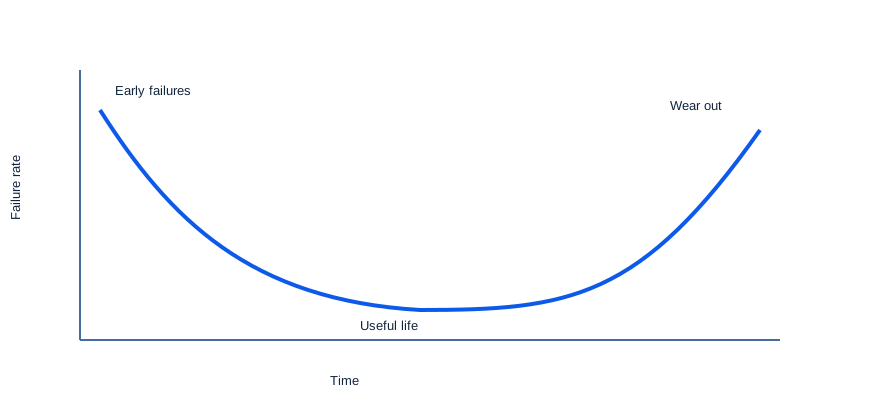
Many physical systems show a bathtub curve pattern: higher failure rates early (infant mortality), a long “useful life” of relatively stable performance, and rising failures later (wear-out). The chart below is a simple mental model. Real devices mix many failure modes, so the curve is never this tidy in data, but the idea is still useful: your plan must cover all three regions.
Early failures are often about manufacturing, handling, and missed edge cases. Wear-out is about battery chemistry, moving parts, connection cycles, and heat stress over years. MTBF and similar numbers can help plan service inventory, but they are not a guarantee for any specific unit. Treat them as planning inputs, not a substitute for validation in representative environments.
Power, batteries, and derating
Derating means staying below a component’s maximum ratings on purpose, so temperature swings, age, and manufacturing spread do not push you into failure. In batteries, that often means not designing to “100% of datasheet capacity” for your worst-case long shift. In processors and radios, it means budgeting power so a burst of work does not collapse voltage under load.
Set run-time and charging targets from real workflows. Ask how long a full shift is, whether cold storage changes behavior, and how often users can recharge or swap. Label claims and verification tests should reflect those assumptions. If the device can run hot when charging while in use, model that combination explicitly, not as two separate best-case tests.
Thermal behavior and throttling
Electronics generate heat. When the device cannot shed heat fast enough, the system may slow clocks, reduce screen brightness, or cap radio duty cycle. That is thermal throttling acting as a safety valve. In medtech, throttling is not just a performance issue: it can change latency, image quality, or alert timing. Good teams define what graceful degradation means for each must-not-fail function before they hit a thermal limit in the field, and they document how long recovery takes after cooling.
Common failure modes in planning
Teams often over-trust temperature-controlled lab results. Real environments include pocket heat, direct sun in transport, high humidity, and vibration. Another gap is “happy path” battery testing without concurrent Wi-Fi, cellular, or high-duty-cycle security work. A third is ignoring field service: who replaces worn parts, how returns are triaged, and what data you get back when a unit fails. Reliability and TCO are linked; cheap hardware with short wear-out can cost more in support and reputation than better-built alternatives.
Design and validation checklist
- Set battery and performance targets from real user workflow duration and worst-case load, not ideal lab demos.
- Plan for thermal throttling and user-visible graceful degradation before critical limits are hit.
- Document environmental assumptions (home, hospital, mobile) and validate a representative sample of them.
- Define field service, spare parts, and replacement policy for the wear-out region of the lifecycle.
- Align service metrics with the same reliability story you use with customers and payers.
Further reading (learning only)
These links support general learning. Product-specific test plans, risk files, and standards applicability must be confirmed with your engineering and quality leads.
- U.S. FDA — Medical devices — context on regulated device quality and postmarket experience.
- IEC Webstore — entry point to internationally harmonized safety and performance standards often referenced in device design.
- NIST/SEMATECH — e-Handbook of Statistical Methods — statistical background often used in reliability and test planning.
- CDC NIOSH — heat stress and workers — user-environment perspective when modeling thermal and workload limits for mobile or field use.
Practical next step
Define the expected use environment and write the top five reliability, battery, thermal, or service risks that could affect pilot success.
- Template or worksheet: prototype to production readiness checklist.
- Glossary terms: MTBF, thermal throttling, graceful degradation.
- Pathway links: Operations, TCO.