Why funding strategy matters
Medtech products usually require longer development timelines than typical software startups because they include validation, quality systems, and integration work. A practical funding plan often blends non-dilutive support with customer pilots and private capital, instead of relying on one source.
What this page helps you decide
This page helps founders connect funding to credible milestones. Grants, tax credits, academic partnerships, health-system collaborations, revenue, and private capital work best when they support a clear technical and evidence roadmap.
Use it before treating funding applications as separate admin work. Strong funding documentation should make the product plan clearer.
Core funding programs founders should know
| Program | What it typically supports | Founder implication |
|---|---|---|
| SR&ED | Tax incentives for eligible R&D activities and technical uncertainty work. | Maintain clear technical documentation and time/cost tracking from day one. |
| Mitacs | Industry-academic collaborations, often via internships and applied research projects. | Use university partnerships to accelerate targeted technical milestones. |
| NSERC | Research collaborations and innovation programs with post-secondary partners. | Useful for deeper engineering work and prototype validation with faculty teams. |
| CIHR | Health-focused research funding and translational pathways. | Strong fit when clinical evidence generation is central to the roadmap. |
| Alberta Innovates | Provincial innovation support across commercialization, technology, and scale-up stages. | Can help bridge pilot-to-growth gaps and strengthen local ecosystem ties. |
| AHS-related pathways | Clinical partnership opportunities, pilot environments, and system-facing validation routes. | Engage early with workflow owners and evaluation criteria before technical build-out. |
University ecosystem and health system alignment
University ecosystems can provide research expertise, trainee capacity, and access to specialized labs. For founders, this can reduce early prototype risk and improve technical credibility. Health-system collaboration, including AHS-adjacent pathways, helps teams validate real workflow fit and strengthen evidence narratives for procurement and adoption.
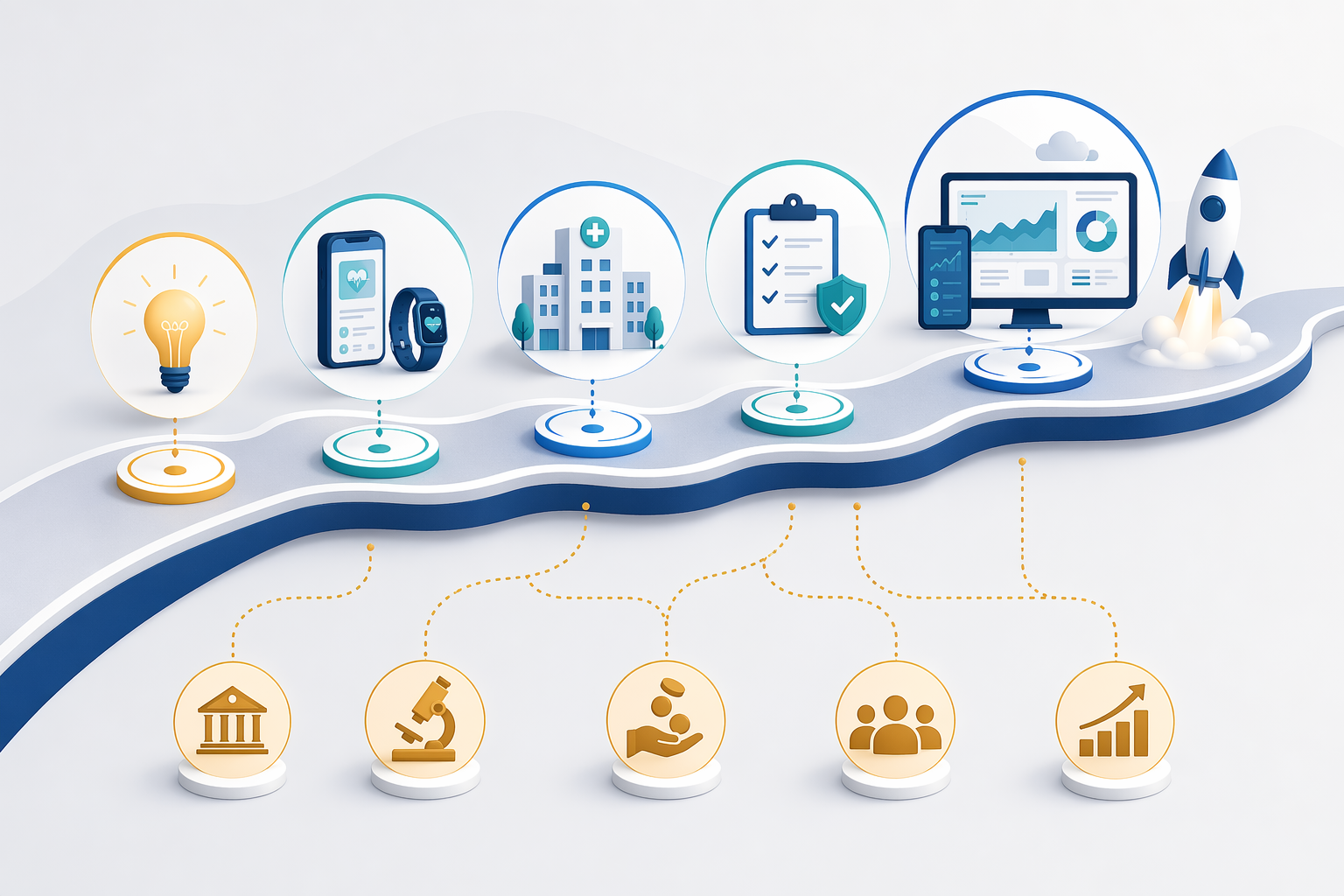
The strongest plans connect these tracks: use university collaboration for technical milestones, provincial and federal programs for funding leverage, and health-system partnerships for implementation readiness.
Practical funding roadmap
- Map 12-24 months of milestones: prototype, validation, integration, and pilot outcomes.
- Align each milestone to an appropriate funding mechanism (tax credit, grant, partnership, revenue).
- Set evidence and reporting requirements upfront so one workstream supports multiple applications.
- Build a calendar for submission windows, review periods, and cash-flow timing.
Official references
Curriculum page last reviewed: 2026-04-22.
Program rules and eligibility change; verify deadlines and criteria on official sites before applying.
Practical next step
Build a 12-24 month funding stack that maps each milestone to a funding source, evidence requirement, owner, deadline, and cash-flow assumption.
- Template or worksheet: Gantt schedule template.
- Glossary terms: SR&ED, Mitacs, CIHR.
- Pathway links: Reimbursement and TCO, Capstone case study.