In plain language
AI can help medical products move faster, spot patterns, and reduce repetitive work. It can also create false confidence if teams treat it like a magic layer instead of a tool with limits. For non-technical founders, the right starting point is simple: AI is useful when it improves a workflow without hiding who remains responsible for the final decision.
That matters because AI systems can look impressive long before they are dependable. A model can produce convincing outputs in a demo while still failing on edge cases, behaving unevenly across patient groups, or becoming hard to explain when performance changes. In medtech, those risks are not side notes. They shape whether the product can be trusted.
What this page helps you decide
This page helps learners place AI in the right role. AI can speed up drafting, triage, summarization, pattern recognition, and workflow support, but it does not remove human responsibility for claims, safety, privacy, security, validation, monitoring, and change control.
Use it when a team is tempted to describe AI as only assisting without checking how users will actually rely on it in the workflow.
Where AI usually helps
AI is often strongest when it improves speed, consistency, or prioritization inside a workflow that still has clear human accountability. That includes summarizing information, highlighting cases that need review, supporting documentation, and assisting with repetitive low-risk tasks. In those situations, the AI is helping people work better rather than acting as an unexamined replacement for judgment.
- Decision support with clear confidence displays.
- Prioritization and triage where clinicians keep final authority.
- Administrative automation for low-risk repetitive tasks.
A useful test is to ask what happens if the model is wrong. If a wrong answer can be caught, reviewed, and corrected by a human in a controlled way, AI may be a good fit. If a wrong answer could quietly drive unsafe action or create hidden workflow risk, the bar for using AI should be much higher.
Where teams get into trouble
Problems start when teams give AI a role that sounds smaller than it really is. A company may say the model is “only assisting,” but in practice clinicians or staff may start trusting it as a recommendation engine. The interface design, the workflow timing, and the confidence language all influence that shift. If the product makes it too easy to treat a suggestion like a decision, the true risk is higher than the intended use statement suggests.
Another common problem is weak data discipline. AI systems reflect the quality of the data, labels, and workflow context used to create them. If training data is narrow, messy, biased, or disconnected from real use conditions, the model may perform well in internal testing but poorly in live settings. Founders do not need to become ML engineers, but they do need to understand that model quality is inseparable from data quality and workflow design.
Boundary decisions before building
- Is the AI output advisory, administrative, triage-supporting, or directly decision-driving?
- Who is expected to review it before action is taken?
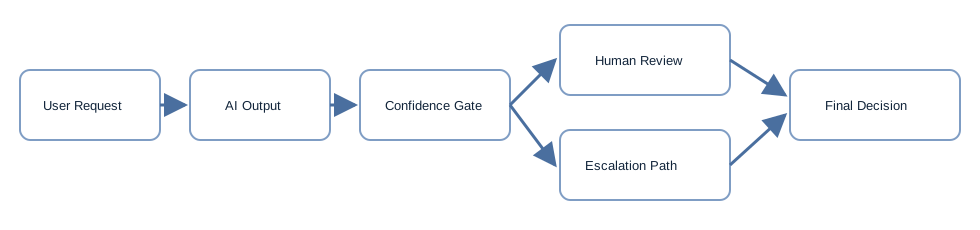
- What should happen when the model is uncertain, unavailable, or contradicted by other information?
- Which users or patient groups might be harmed if performance is uneven?
- What evidence would show the feature improves the workflow without hiding new risk?
Worksheet
Use the AI boundary decision worksheet to define what the AI can do, when human review is mandatory, and what triggers rollback.
Guardrails
Guardrails are the practical controls that stop an AI feature from drifting into unsafe or poorly understood use. In plain language, they define where the model can be used, when humans must step in, how performance is reviewed, and what happens if results become unreliable.
- Document intended use and non-use conditions.
- Set review thresholds for low-confidence outputs.
- Track real-world performance across sites and populations.
- Define rollback triggers when behavior drifts.
These controls matter even for internal-facing tools. Once a system influences workflow, people adapt to it quickly. That is why you need clear review boundaries and a rollback plan before the feature becomes operationally important.
AI-assisted building and vibe coding
Many founders now use AI tools to generate screens, code, and workflows by describing what they want in plain English. This is often called vibe coding. It can be genuinely useful in the earliest stages because it helps teams move from an idea to a visible prototype quickly. It lowers the barrier to experimentation and can help non-technical teams understand what they are trying to build.
The danger is confusing fast output with engineering maturity. AI-generated code may look polished while hiding weak structure, missing tests, poor security practices, and unclear ownership. In medtech, that matters a lot. A prototype produced with AI can be a good learning tool, but it is not automatically a safe or maintainable product asset.
A practical rule is to use AI to accelerate drafting, not to outsource responsibility. If AI creates part of the product, someone on the team still needs to understand how it works, what assumptions it makes, how it is tested, how it fails, and how it will be updated. If no human owner can explain that clearly, you do not yet have something ready for serious use.
Concrete advice for non-technical founders using AI tools
Use AI-generated output where the cost of being wrong is low and the purpose is learning: mockups, internal admin tools, content drafts, or early workflow experiments. Slow down immediately when the feature touches patient data, clinical decision support, security controls, interoperability, or anything that would need formal evidence and dependable maintenance.
Before accepting AI-generated work, ask for a named human owner, a plain-language architecture explanation, tests, a list of dependencies, known limitations, and a rollback plan. Ask what parts were generated, what parts were reviewed manually, and what still needs verification. Those questions help separate a useful prototype from an unmanaged risk.
What this means for founder decision-making
You do not need to reject AI. You do need to put it in the right role. The strongest founder posture is neither fear nor hype. It is disciplined curiosity. Use AI where it increases speed without blurring accountability. Be skeptical whenever a tool promises to remove the need for engineering judgment, quality review, or clear documentation. In regulated and safety-sensitive environments, those responsibilities do not disappear just because the first draft was fast.
Regulatory expectations founders should recognize (2025–2026)
North American regulators now publish detailed expectations for machine learning in medical devices. You do not need to memorize them, but you should know the vocabulary your regulatory and quality partners use.
Predetermined Change Control Plan (PCCP)
A PCCP describes planned changes to an AI or ML component (for example retraining within defined data bounds), the protocols to implement and verify those changes, and the impact on safety and effectiveness. When authorized as part of a licence or submission, it can reduce friction for controlled updates that stay inside pre-reviewed limits. It is not a substitute for risk management or evidence—it is a structured way to bound change. Compare FDA’s AI-enabled device software function PCCP guidance with Health Canada’s MLMD pre-market guidance and PCCP principles.
Good machine learning practice (GMLP)
GMLP is the lifecycle discipline for data, training, evaluation, and monitoring. Health Canada’s MLMD guidance ties GMLP to design, risk management, transparency, and post-market monitoring. The joint FDA–Health Canada–MHRA Good Machine Learning Practice for Medical Device Development: Guiding Principles remains a practical entry point for teams.
SGBA Plus (sex- and gender-based analysis plus)
Regulatory reviewers increasingly expect analysis of how sex, gender, and intersecting factors may affect performance and access. For founders, the operational question is whether training, testing, and clinical validation cover representative Canadian populations and care settings—not only convenience cohorts.
Model cards and data cards
These documents summarize intended use, data provenance, known limitations, and performance across subgroups. They support transparency internally and with reviewers. Use the curriculum templates for starter formats.
Clinical validation and evidence depth
Bench testing and offline metrics are rarely sufficient alone when software influences clinical decisions. Health Canada’s MLMD guidance distinguishes expectations by class; confirm with regulatory counsel what clinical validation and real-world evidence plans apply to your device.
Post-market monitoring
Plan for drift, incident feedback, and compatibility before launch. Monitoring is a regulatory topic, not only an MLOps topic—connect it to model change control and your surveillance plan template.
Official references
Curriculum page last reviewed: 2026-04-22.
Summaries are for learning only; AI/ML submissions are fact-specific.
- Health Canada — Pre-market guidance for machine learning-enabled medical devices (2026-04-01)
- FDA, Health Canada, and MHRA — Good Machine Learning Practice for Medical Device Development: Guiding Principles
- FDA, Health Canada, and MHRA — Guiding principles: Predetermined change control plans for MLMDs
- FDA — Marketing submission recommendations for a PCCP for AI-enabled device software functions (reissued 2025-08-18)
Practical next step
Define the AI boundary for one feature: output type, user action, human review point, uncertainty behavior, rollback trigger, and evidence needed before pilot use.
- Template or worksheet: AI boundary decision worksheet.
- Glossary terms: human in the loop, performance drift, PCCP.
- Pathway links: Model monitoring, Data governance.