In plain language
Architecture is the high-level shape of your system. It describes where different parts of the work happen, how information moves, and what depends on what. For non-technical founders, this matters because architecture choices influence speed, reliability, cost, security, and how hard the system will be to operate later.
A simple way to think about architecture is to ask where the important work lives. Does most of it happen in the cloud, on a device, or across both? Each answer creates a different set of strengths and tradeoffs. Architecture is not an abstract technical preference. It is a practical decision about risk, responsibility, and failure modes.
What this page helps you decide
This page helps teams choose a system shape that matches the product risk, workflow, latency, integration, data governance, and support model. Architecture is not only a technical preference; it changes what the team must validate, monitor, secure, and pay for.
Use it before committing to cloud-first, edge-heavy, or hybrid assumptions that will be expensive to reverse later.
Common patterns
Architecture is how you divide responsibility across systems. A cloud-first model centralizes intelligence and is often simpler for analytics-heavy products. An edge-heavy model keeps more logic on-device, which can improve resilience when connectivity is unstable. Most founder teams end up in a hybrid model because it balances performance, reliability, and operational flexibility.
In plain language, a cloud-first system is like keeping most of the brains in a central office. That can make updates and analytics easier, but it increases dependence on network connectivity and remote infrastructure. An edge-heavy system keeps more decision-making close to the user or device, which can improve responsiveness and resilience but makes updates and fleet management harder. A hybrid system splits those responsibilities, which is often practical but usually more complex to design well.
| Pattern | Best for | Tradeoff |
|---|---|---|
| Cloud-first | Fast updates and central analytics | Network dependency and data governance burden |
| Edge-heavy | Low-latency decisions and intermittent connectivity | Harder update and fleet management |
| Hybrid | Balanced reliability and flexibility | Higher architecture complexity |
How founders should think about the choice
The right pattern depends on what must happen instantly, what can tolerate delay, what data needs to travel, and what your team can safely maintain. If the product must continue working during poor connectivity, pushing more logic to the edge may make sense. If the biggest value comes from centralized reporting, analytics, or coordination across sites, cloud services may deserve a larger role.
Founders should also think about failure in plain terms. What happens if the internet connection is slow? What happens if a device is offline? What happens if a cloud service is unavailable? Good architecture conversations are really conversations about what should keep working when parts of the environment fail.
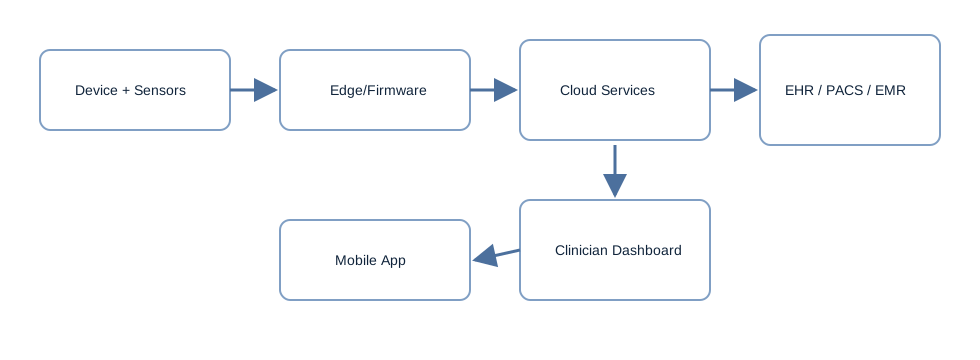
Architecture review checklist
- Can the team draw the system and label every data handoff?
- Which component owns identity, permissions, audit logging, and consent state?
- What keeps working when the device, app, network, cloud service, or integration is unavailable?
- Which parts are hardest to replace later, and why are those choices acceptable?
- Who will monitor, patch, and support each major component after release?
Canada/Alberta founder decision points
In Canada, data governance and contractual obligations can matter as much as technical elegance. Alberta teams often need clear justification for where data is processed, who can access it, and how incidents are managed. Architecture choices should therefore be made jointly by product, engineering, privacy, and operations leads.
- Keep safety-critical decision logic close to the point of care when latency matters.
- Use cloud analytics for population trends and remote monitoring.
- Design APIs with explicit versioning and fallback behavior.
In practical terms, this means that a technically attractive architecture can still be the wrong choice if it complicates privacy review, procurement, contracting, or incident handling. Founders should treat architecture as a cross-functional decision, not just an engineering preference.
Common mistake patterns
One common mistake is choosing an architecture that looks scalable before the team has proven the core workflow. Another is copying an enterprise-grade pattern from a much larger company even though the startup does not have the staffing to run it well. Both patterns create avoidable complexity.
A different mistake is staying too simple for too long and ignoring obvious risk. If a system depends heavily on connectivity or has no clear fallback behavior, the founder should ask whether the architecture still matches the real-world use environment. Good architecture is not about maximum simplicity. It is about the right level of complexity for the actual problem.
Team maturity and stack maturity should match
If your team is small, choose a simpler stack with strong documentation and predictable operations. Complex multi-service architectures can be powerful, but they require experienced developers and DevOps capacity. A common founder strategy is to start with a stable, maintainable baseline and add complexity only when user growth or risk profile justifies it.
For many early teams, this means choosing fewer moving parts, stronger conventions, and clearer ownership. Systems that are easy to explain are usually easier to hand off, monitor, and improve. That matters more than theoretical elegance when the company is still building execution discipline.
Concrete advice for non-technical founders
Ask your technical team to draw the system on one page and explain it without jargon. Where does data enter? Where is it processed? What happens on the device? What happens in the cloud? What happens if one component fails? If the answer cannot be made simple, the design may still be too unclear or too complicated.
Also ask which parts of the architecture will be hardest to change later. That question helps you focus on the decisions that deserve the most scrutiny now. In many products, the most expensive mistakes are not in the feature list. They are in the early structural choices that quietly shape everything else.
Practical next step
Review one proposed architecture and write the failure behavior for network loss, stale data, server outage, device disconnect, and delayed sync.
- Template or worksheet: architecture review checklist.
- Glossary terms: edge computing, API contract, cloud hosting.
- Pathway links: Hosting and cost, Deployment and observability.