Lesson 03
Story & voices
Write a small story that works aloud, then give each speaker a clear role.
Bring the premise, audience, format choice, and revised outline from Lesson 02: The creative process. This lesson uses the short version to practise dialogue and delivery.
Give the story one clear rule
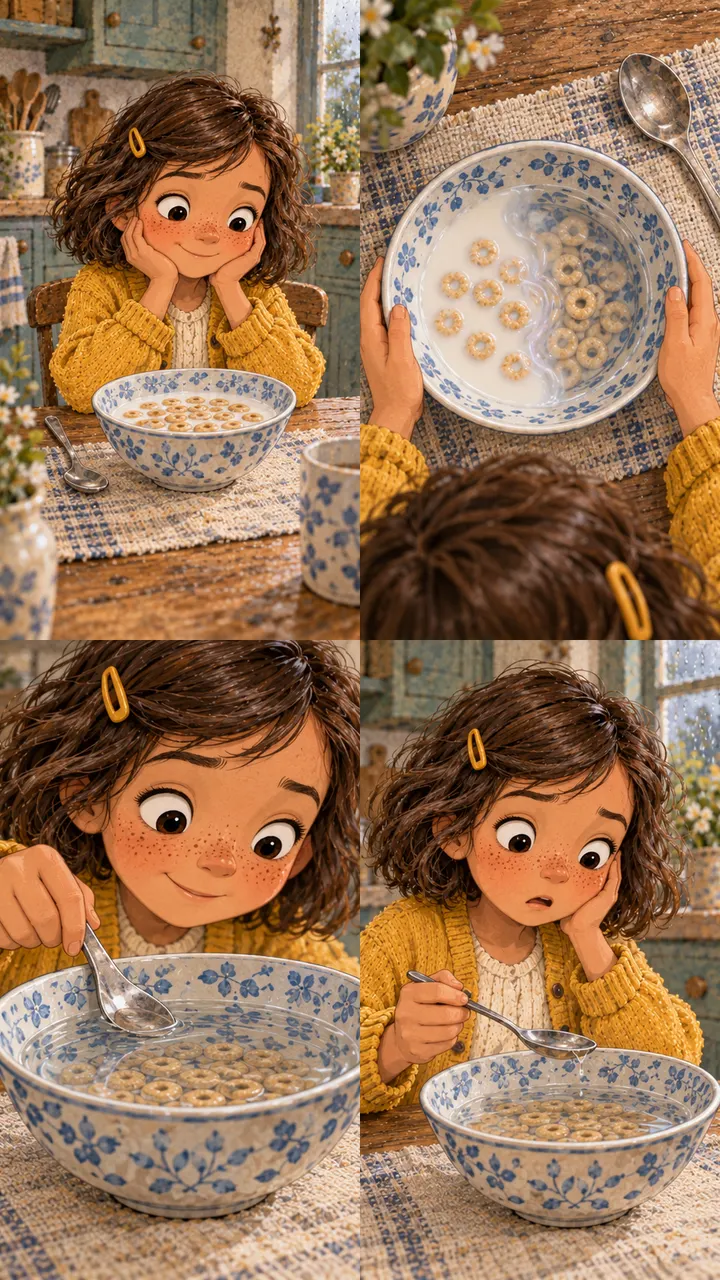
Ellie’s only magic turns milk into water. That limitation gives the story a recognizable shape: an unusual ability, disappointment, a practical use, and a new understanding. A short story is easier to follow when the ending resolves the idea introduced at the beginning.
For your own story, finish this sentence: “A character who can ___ discovers that it helps when ___.” Keep the ability and the problem small enough to explain in a few spoken lines.
A complete practice script
This new example is for the course activities; it is not a transcript of Ellie. Copy it into your notes or write a similar four-beat story of your own.
[NARRATOR]
Mira's lantern only lit lost things.

[MIRA]
Why won't it light the path?

[NARRATOR]
Then a tiny glow appeared beneath a leaf.

[MIRA]
Your key! Maybe this light is enough.
The labels show who speaks. They are a planning convention, not commands to run. Each block is one beat: a small unit of action or meaning. If you record the example, speak only the dialogue and narration, not the labels.
Make a cast brief
Describe the delivery before choosing a voice. Ellie used generated voices through Kokoro; you can plan the same performance or record your own reading.
| Speaker | Delivery | Listen for |
|---|---|---|
| Narrator | Warm, steady, curious | A clear setup and a pause before the discovery |
| Mira | Questioning, then pleased | A change in feeling between the two lines |
Timing comes from the reading
Read the script aloud at a comfortable pace and time it. Punctuation suggests pauses, but a blank line does not guarantee a particular silence in a speech tool. Record the pauses you want or plan to add them during editing.
If a line feels rushed, shorten it or give it more time. The timeline example in Lesson 06 allows 20 seconds, including pauses; your recording may need a different length.
Voice adjustments
Speed changes affect pacing; pitch changes affect how high or low a voice sounds. Raising pitch alone does not make a convincing child character. Ellie’s production experimented with both, but your first priority is understandable, expressive speech. Compare one adjustment at a time.
Try two performances
Read “Maybe this light is enough” once as a relieved discovery and once as a flat statement. Keep the words the same. Notice which version makes the ending clearer. This is the kind of judgment you still need when a model generates the speech.
Activity · Script and cast
Write or adapt four beats with no more than two speakers. Add a delivery note for each speaker. Read the whole script aloud, then revise one line that feels awkward. If you can, record two takes on a phone; otherwise note where you pause.
Checkpoint
Your script identifies every speaker, sets up one idea, and resolves that idea in the final beat. You have an approximate reading time and a reason for your voice choices.