Lesson 02
The creative process
Find an idea worth following, choose the space it needs, and revise until every beat gives the audience a reason to stay.
Your output
A one-sentence premise, an audience and emotional promise, two outlines at different lengths, and one revised opening and ending. A notebook or blank document is enough.
Before choosing voices or generating pictures, decide what the story is asking the audience to care about. A beautiful scene can establish a world, but a character’s desire, difficulty, and response give that world a story.
1. Start with something specific
Collect small observations: a task that went wrong, an object someone kept, an ability that seemed useless, or a moment when someone changed their mind. Turn the observation into a question: “What if this ordinary problem met one unusual constraint?”
Ellie’s constraint is simple: her magic turns milk into water. That gives the story both a difficulty and a possible solution. The idea becomes interesting when the character must discover what the ability is good for.
- List three seeds: an everyday problem, a surprising object or ability, and a feeling you want to explore.
- Combine them three ways: change the character, limitation, or consequence. Keep each possibility to one sentence.
- Look for visible action: what could a viewer actually see the character try?
- Choose a workable question: what would make you want to know what happens next?
Someone wants ______,
but ______ gets in the way.
They try ______,
which leads to ______.
By the end, ______ has changed.
Keep the stakes appropriate to the story. A lost key, a disappointed friend, or an unfinished gift can matter when we understand why it matters to the character. You do not need a world-ending threat.
2. Know who you are telling it to
Name a particular viewer and an intended feeling. “A warm story for a child who feels their talent is too small” gives you more useful direction than “something everyone will like.” Decide what the viewer needs explained and what they can infer from an image.
Write an emotional promise: by the end, the viewer should feel curious, relieved, amused, understood, or something else you can name. The opening invites that feeling; the ending should earn it through what happens.
A quick idea test
Say the premise aloud without describing the art style or tools. Can another person tell you what the character wants and what makes it difficult? If they can only repeat the setting, develop the action before producing media.
3. Choose the length the idea can support
Story length and screen shape are separate choices. A vertical frame does not determine how much story you need. Choose duration by the number of meaningful changes the audience must follow, then choose framing for how they will watch.
The ranges below are practice constraints, not platform limits or guaranteed attention spans. The course’s later worked example remains about 20 seconds; this exercise also explores what a longer treatment would require.
| Question | Short version About 20–40 seconds | Longer version About 3–5 minutes |
|---|---|---|
| What fits? | One central question and a clear turn or discovery. | A central question developed through attempts, choices, and consequences. |
| What to establish? | Just enough context to understand this moment. | The goal, relationships, and rules needed for later choices to matter. |
| What earns time? | A line or picture that changes understanding. | A scene that changes the plan, raises a cost, or reveals relevant information. |
| What to avoid? | Several competing premises or a rushed explanation. | Repeated attempts with the same result or backstory that never matters. |
If the short outline needs a paragraph of explanation before anything happens, simplify the premise or allow more time. If the longer outline repeats its middle, find a meaningful consequence or make a shorter story. Adding duration should give the viewer more to understand or feel.
One premise, two treatments
Premise: Mira has a lantern that only lights lost things. She discovers that its limitation can help someone. These are planning examples for your own adaptation, not scenes you need to download.
A short: discovery and payoff
- Setup: Mira’s lantern will not light the path.
- Question: she wonders what use it could be.
- Discovery: a glow appears beneath a leaf.
- Payoff: she finds a lost key and sees the lantern’s value.
The short concentrates on one change in understanding. The next lesson turns this compact version into a spoken script.
A longer story: attempts that change the plan
- Give the goal a person: a neighbour has lost a key and cannot get home before dark.
- Show the limitation: Mira tries to use the lantern as an ordinary light; the path stays dark.
- Let an attempt have a cost: she follows glows to unrelated lost objects while daylight fades.
- Make her choose differently: she stops following every glow and asks the neighbour to retrace the day.
- Pay off the choice: the remembered route leads to the leaf and the missing key.
- Leave room for a reaction: the neighbour’s relief changes how Mira thinks about her small ability.
Each added scene changes what Mira knows or does. The ending comes from her choice to listen as well as the lantern’s established rule. A suddenly all-powerful lantern would weaken that connection.
4. Give the audience reasons to keep watching
- Open a specific question. A lantern glowing under a leaf invites “What is there?” A long introduction about lantern history delays the action.
- Make the promise honest. The opening should point toward something the story actually resolves. Do not imply a revelation the ending never provides.
- Connect events through cause and effect. “She follows every glow, so she loses time; because time is running out, she asks for help” gives the middle direction.
- Vary the kind of beat. Action, a reaction, a revealing detail, and a quiet pause can all move the story. Interest does not require constant cuts or new surprises.
- Let pictures carry information. Show the dark path or worried neighbour rather than explaining every visible detail aloud.
- Pay off a planted detail. Introduce the lantern’s rule early enough that the key’s glow feels earned. Surprise can change our interpretation without breaking the rules.
For each beat or scene, write: “Before this, the viewer thinks ___. After this, they know or feel ___.” If the answer does not change, consider cutting the beat, combining it with another, or giving it a clearer purpose.
5. Iterate while changes are still cheap
Test the outline before polishing dialogue, and test the dialogue before making a full set of pictures. Keep versions so you can compare a specific change instead of losing the earlier idea.
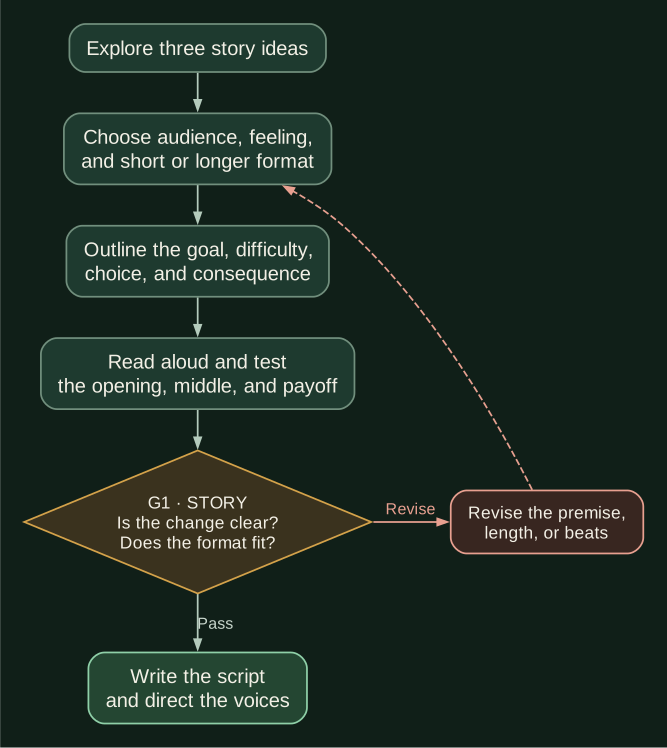
- Outline: test the goal, difficulty, choice, and outcome. Revise the structure before polishing individual words.
- Read aloud: time the delivery and mark where you rush or lose the thread. Give pauses a purpose.
- Ask for evidence: “What did the character want?”, “Where were you confused?”, and “What did you expect the ending to resolve?” are more useful than “Did you like it?”
- Change one major thing: try a different opening, remove a repeated attempt, or clarify a consequence. Read again and compare the result.
If you are reviewing alone, leave the draft for a while, then read it without adding explanations. Mark where the page fails to carry an idea you had in your head. Treat that as a provisional review until someone else can respond.
G1 · Creative revision gate
Continue when: you can name the audience and emotional promise, explain why this format fits, and show how the ending follows from the setup. Each beat or scene should change the action, understanding, or feeling. Record the reading time and any feedback still needed.
Revise when: the hook promises a different story, the middle repeats, the rules change only to rescue the ending, or the chosen length forces you to rush or pad. Return to the premise, format, or outline before producing assets.
Use an AI agent to explore, then choose
Use G1 on your outline now, then repeat it after writing the dialogue in the next lesson. A stronger performance cannot fix a missing story connection, and a promising outline still needs a clear script.
Ask for contrasting possibilities and the cost of each. Keep the decisions about meaning, taste, and audience visible. You can give your agent this prompt alongside the downloadable instructions:
My audience is: [describe the viewer]
I want them to feel: [emotional promise]
My starting idea is: [one sentence]

Suggest three different story premises from this idea.
For each, name the goal, obstacle, choice, and outcome.
Identify what may be confusing or hard to show.

Help me choose one. Outline it as a short and as a
longer story. Explain what the extra scenes contribute.
Do not add scenes just to reach a duration.
Help me test the opening, middle, and payoff at G1
before moving into voices, images, or video tools.
Activity · Develop, compare, revise
Write three premises. Choose one and outline both a short and a longer version. State which you would make first and why. Read that outline aloud, rewrite one weak part, and record what changed. For the core course assignment, carry a four-beat short into the next lesson; keep the longer treatment as an optional extension.
Checkpoint
You have a premise, an intended viewer and feeling, a justified format choice, a sequence with a meaningful turn, and a revision supported by something you noticed or heard. Next, turn the selected outline into dialogue and voice direction.