AI, Virtual Care, and Accreditation
Strengthening Indigenous Health Systems Through Responsible Innovation
Sidney Shapiro, PhD
Assistant Professor of Business Analytics
Dhillon School of Business
University of Lethbridge

Context: Why This Conversation Now?
- Severe health human resource shortages across Canada
- Colonial legacies, underfunding, and barriers to care have contributed to health disparities.
- Higher prevalence of chronic conditions in many First Nations communities
- Geographic and infrastructure barriers to care access
- Increasing digital infrastructure in rural and remote regions
- Accreditation focus on quality, safety, and continuous improvement
A Brief History of AI
Early Foundations (1950s–1980s)
- 1950: Alan Turing proposes the "Turing Test"
- 1956: Dartmouth Conference coins "Artificial Intelligence"
- 1960s–70s: Expert systems and rule-based AI
- 1980s: First AI winter—limited computing power
Modern Era (1990s–Present)
- 1990s: Machine learning gains traction
- 2000s: Big data enables better training
- 2010s: Deep learning breakthroughs (ImageNet, AlphaGo)
- 2020s: Large language models transform productivity
What Are Large Language Models? (Generative AI)
What they are
LLMs are AI systems trained on vast amounts of text to understand and generate human-like language:
- Neural networks with billions of parameters
- Trained on internet-scale text data
- Predict the next word based on context
- Can summarize, draft, and support documentation
Growth and adoption
- 2023: ChatGPT reaches 100M users in 2 months
- 2024: Widespread use in enterprise and health
- 2025: AI tools become standard in workflows
Tim Hortons

AI in Health: What We Actually Mean
AI in health typically includes:
- Clinical decision support tools
- Risk prediction models
- Automated triage systems
- Remote patient monitoring
- Documentation automation
- Population health analytics

Data, ETL, and Finding New Patterns
Many of the gains from AI in health depend on how data is gathered and prepared. ETL—Extract, Transform, Load—describes the pipeline: pulling data from source systems (E), cleaning and structuring it (T), and loading it into a place where it can be analyzed or used by AI (L).
- In your context: Data might come from visits, program reports, community surveys, or accreditation evidence. When it’s extracted and transformed consistently, it becomes usable.
- AI on that data: Once data is in a structured form, AI can look for patterns—trends in service use, gaps by community or program, early signals of risk—that are hard to see in spreadsheets or paper.
The Health Human Resources Crisis
Challenges:
- Provider shortages
- Burnout
- Recruitment and retention barriers
- Increased chronic disease burden
- Long wait times and travel requirements
Where AI Can Bridge Gaps
1. Virtual Triage and Access
- AI-assisted intake systems
- Symptom prioritization
- Directing patients to appropriate services
2. Chronic Disease Management
- Remote monitoring for diabetes, hypertension
- Risk alerts for early intervention
3. Documentation Burden Reduction
- Automated note generation
- Structured data extraction
- More provider time with patients

AI in Use Today: Real Examples
AI is already supporting clinicians and patients in concrete ways:
AI tools can listen to the conversation between provider and patient and generate structured clinical notes in real time—freeing the provider to focus on the person, not the keyboard.
- Reduces documentation burden during and after visits
- Improves accuracy and consistency of records
- Supports accreditation-ready documentation
Accreditation Lens: Where AI Actually Touches Your Work
The pressure point is often evidence at review time—showing that improvement is systematic, that documentation is consistent, and that risk is identified before it becomes a finding.
- Documentation that reviewers can trust: AI-assisted notes and summaries only help accreditation if they’re accurate, verifiable, and aligned with what actually happened. Otherwise they create risk.
- From “we do it” to “we can show it”: Dashboards and pattern-finding can surface the right data at the right time—so you’re not reconstructing the story after the fact.
- Consistency across sites and programs: Standardized extraction and reporting can reduce the gap between locations that document well and those that struggle, so the organization presents a coherent picture.
You are not Google
Most organizations are not looking for build technology for technology's sake. You are looking to improve your workflow and your organization to meet the needs of your community.
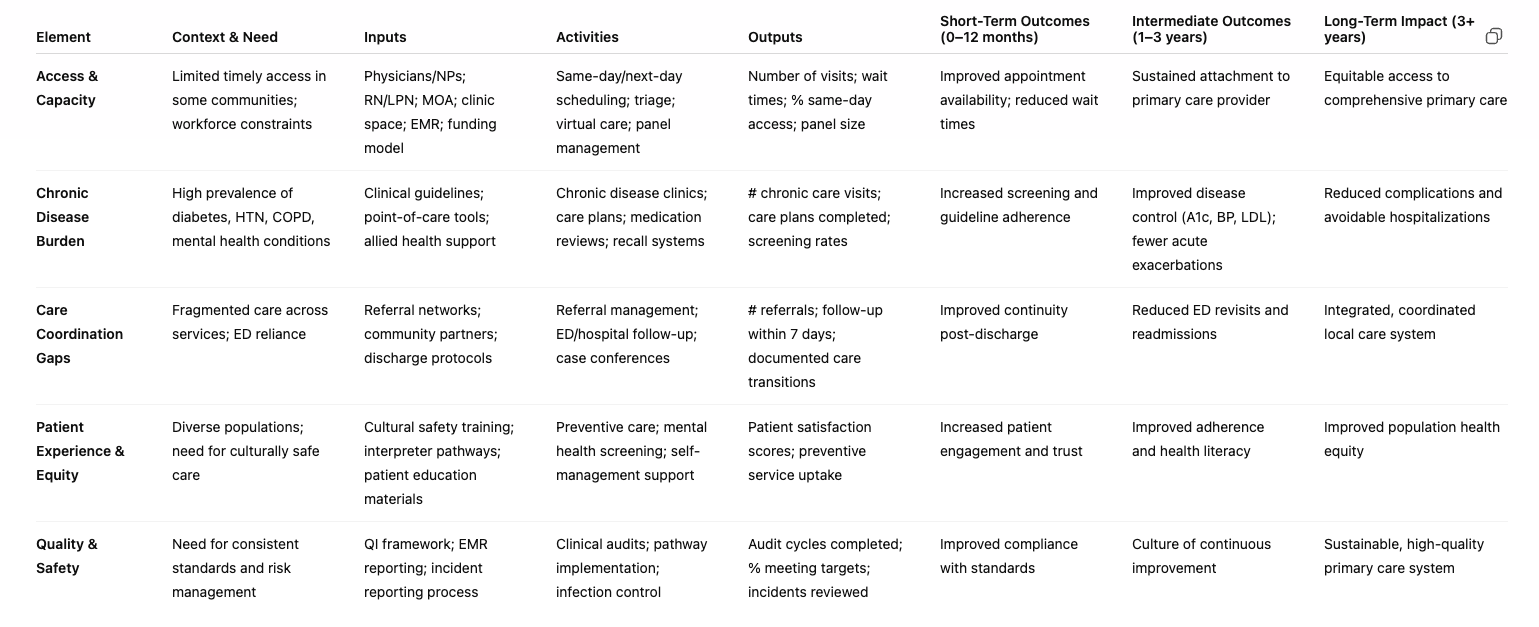
Using AI for Logic Models, Theory of Change, Gantt Charts, M&E Plans, and Related Evaluation Tools
AI can be used to help with the creation of logic models, theory of change, Gantt charts, and related evaluation tools.
AI as a Quality Improvement Tool
AI strengthens:
- Evidence-informed decision making
- Outcome measurement
- Service equity monitoring
- Pattern detection across programs
Risk and Governance Considerations
Accreditation requires safeguards.
Key issues:
- Data sovereignty and governance
- Algorithmic bias
- Transparency and explainability
- Informed consent
- Procurement and vendor accountability
- Vendor lock-in and data ecosystems

Indigenous Innovation in AI
Indigenous Pathfinders in AI – Mila (Montreal)
- Training First Nations, Inuit, and Métis AI leaders
- Building internal capacity rather than external dependence
First Nations Technology Council
- “The Missing Code” initiative
- Aligning AI adoption with Indigenous rights and governance
First Languages AI Reality (FLAIR) – Mila
- AI for Indigenous language revitalization
- Connects technical capacity with community-led language work
First Nations Information Governance Centre (FNIGC)
- Foundation for how health and AI systems should be governed in First Nations contexts
Indigenous Pathfinders in AI (Mila)
Montreal-based program building Indigenous leadership in AI:
- Trains First Nations, Inuit, and Métis individuals to lead in AI development—not only to use it
- Creates internal capacity so communities are not dependent on external vendors
- Ensures Indigenous perspectives shape how AI is built and governed
First Nations Technology Council: The Missing Code
British Columbia initiative ensuring AI adoption respects Indigenous rights:
- “The Missing Code” addresses the gap between mainstream AI development and Indigenous rights and self-determination
- Works so that AI adoption in BC aligns with First Nations governance and data sovereignty
- Bridges technology policy and Indigenous leadership
Language & Cultural Preservation
AI and language technology are being used to revitalize Indigenous languages and preserve traditional knowledge:
- Speech recognition and language models for Indigenous languages
- Digital archives of traditional knowledge
- Canada: The NRC Canadian Indigenous Languages Technology Project works with Indigenous communities to develop speech- and text-based tools (e.g. ReadAlong Studio, predictive text, verb conjugators) for over 25 languages; software is released to communities as open-source.

AI for Holistic & Culturally Informed Care
AI can support care that reflects community values, connection to land, and whole-person wellbeing—when it is designed and trained with those goals in mind.
- Whole-person care: Models can be trained to recognize patterns that matter in Indigenous health—family and community context, connection to culture, social determinants, and spiritual wellbeing—not only clinical symptoms.
- Community-specific patterns: AI trained on data that reflects First Nations populations can learn unique patterns of health, resilience, and need that generic models miss.
Practical Applications: Knowledge & Environment
AI is used to blend traditional knowledge with scientific data:
- Qikiqtaaluk Corporation (Arctic): Environmental management and decision support using both local knowledge and data
- Mapping new fishing locations by combining traditional ecological knowledge with scientific and sensor data
- Supporting land and resource management in ways that respect Indigenous governance

What This Means for Health Accreditation
When aligned with your existing quality and governance expectations, AI can help close the gap between day-to-day practice and what reviewers need to see.
AI adoption can support:
- Documentation quality
- Standardized care pathways
- Improved reporting
- Continuous quality monitoring
- Staff workload sustainability
- Create apps that support the work of the organization
The payoff is not only efficiency—it is clearer evidence of systematic improvement and risk management for your organization.
Strategic Questions for Accreditation Leaders
- How could AI reduce risk in your service delivery?
- Where are documentation burdens slowing quality improvement?
- What data do you wish you had in real time?
- How can Indigenous data governance be embedded from the start?
- What standards would you require before approving AI tools?
- Where does AI make sense in your organization?
Practical Starting Points
Think about the work you do. What can AI help you do better? What are the workflows that could be improved with AI?
Low-risk entry points:
- Documentation automation pilots
- Predictive dashboards for chronic disease
- AI-assisted quality monitoring
- Virtual triage support
Closing Thought
AI is not a solution on its own.
It is a systems amplifier.
When aligned with Indigenous governance, accreditation standards, and quality improvement, it can:
- Expand capacity
- Improve safety
- Reduce burden
- Support equitable access
Discussion
Open conversation:
- What feels promising?
- What feels risky?
- Where do you see immediate opportunity?
- What would accreditation need to see to support AI integration?