AI and the Potato Industry
Growers, Industry & Partners — South Alberta
Sidney Shapiro, PhD • Dhillon School of Business • University of Lethbridge
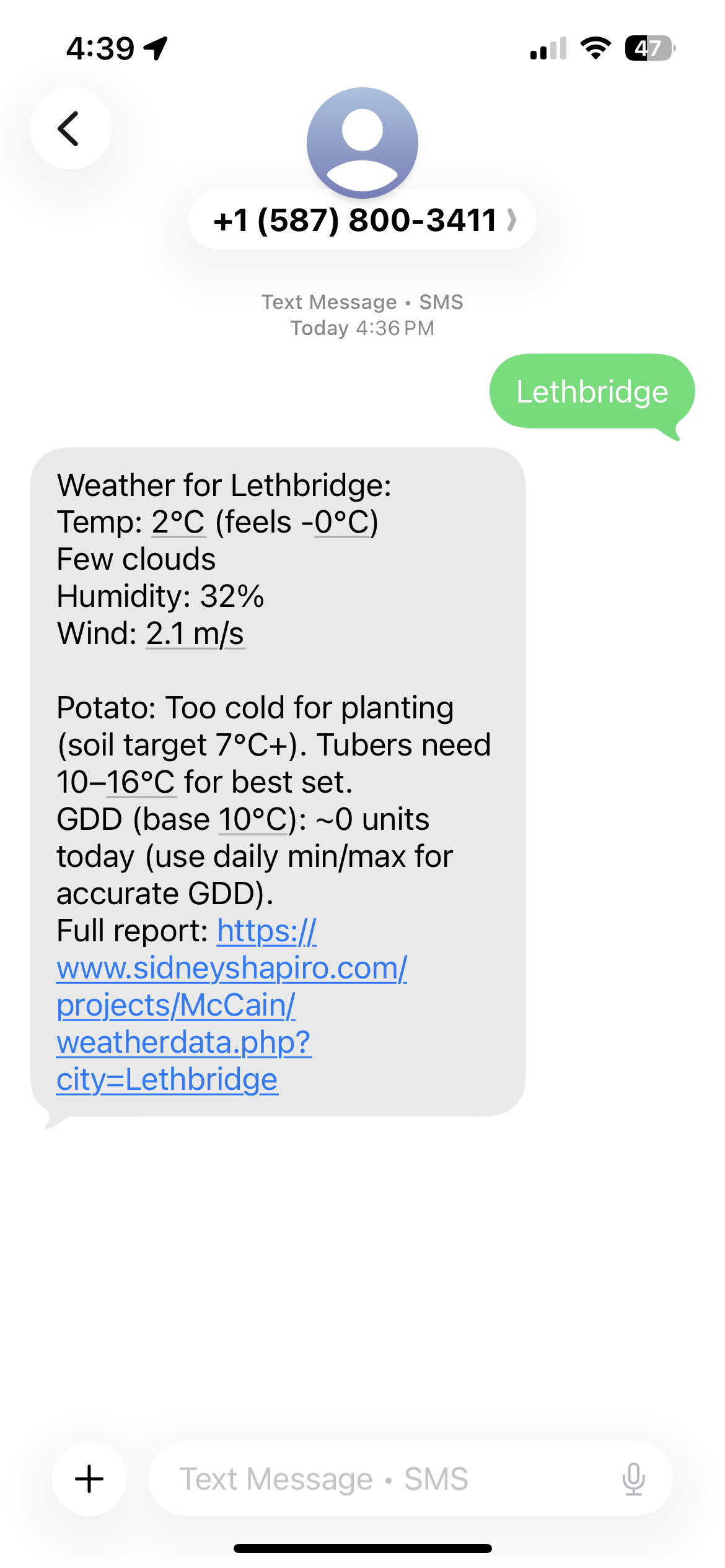
SMS Weather Platform Example
ETL Pipelines
ETL (Extract, Transform, Load) moves and shapes data between systems. The weather SMS webhook is a small ETL pipeline.
In the weather SMS application
- Extract: Incoming SMS (city name) from Twilio; fetch current weather from OpenWeatherMap API.
- Transform: Parse JSON, compute dew point, heat index, wind chill, planting score, potato-growing insights (GDD, frost/tuber messaging), normalize city names.
- Load: Return TwiML (XML) so Twilio sends the formatted SMS back to the user.
Moving data from source to destination
Same pattern scales to moving field data, sensor feeds, or market data into dashboards and models—extract from source, transform for decisions, load where it’s used.
In the potato industry, this can be used to move weather data, field data, and market data into dashboards and models. Data comes from APIs (Application Programming Interfaces), databases, files,and other sources.
What You Told Us
We asked for your questions and how you’re using AI.
Business & workflow
ROI, yield forecasting, data and reporting, SOPs and contracts, trust and privacy, making agronomists more effective.
AI & Machine Vision
Storage tools, disease diagnostics, optical sorting, hyperspectral imaging, seed cutting, robotics—what’s proven and what’s emerging.
Where you are
Many “not using much yet” or testing; others already using ChatGPT for clerical work, optical sorters, data analysis, and research.
What is Artificial Intelligence?
Definition
AI refers to computer systems that can perform tasks typically requiring human intelligence: learning, reasoning, problem-solving, and decision-making.
In agriculture
AI analyzes data from fields, weather, markets, and equipment to provide insights that would be impossible to calculate manually.
- Machine learning: Systems that improve through experience
- Data analytics: Pattern recognition in complex datasets
- Predictive modeling: Forecasting yields, prices, risks
- Automation: Handling repetitive tasks
Key Milestones in AI and LLMs
- 1950s–60s: Birth of AI; early programs for logic and games
- 1990s–2000s: Machine learning takes off; statistical models for speech, search, recommendations
- 2010s: Deep learning; image recognition, translation, and voice assistants improve sharply
- 2017–19: Transformer architecture (attention mechanism); foundation for today’s LLMs
- 2020–22: Large language models (GPT-3, etc.) show few-shot learning and general-purpose text generation
- 2022–now: ChatGPT and rivals go mainstream; GenAI in products, business, and daily workflows
Common Misconceptions About AI
- “AI will replace people”
- “AI is always accurate”
- “You need to be technical”
- “AI is only for big operations”
- AI augments; humans decide and verify
- AI can be wrong—always check outputs
- Many tools need only clear instructions
- Use cases exist at every scale
How AI Works — The Process
1. Data
Weather, soil, yields, market prices, sensor data
2. Patterns
AI finds hidden relationships in the data
3. Learning
System improves accuracy over time
4. Insights
Actionable recommendations for your operation
- ML: A model learns from years of planting dates, weather, and yields—e.g. “planting 3 days earlier when soil hits 8°C often increases yield.” It then alerts you when conditions match.
- Vision: Cameras on the packing line take images of each potato; a model trained on labelled defects sorts “good” vs “defect” in real time.
ML Example
In practice
A model learns from years of planting dates, weather, and yields—e.g. “planting 3 days earlier when soil hits 8°C often increases yield.” It then alerts you when conditions match.
Why it matters
Same idea scales: train on your historical data (storage, varieties, inputs) and get timely, field-specific recommendations instead of one-size-fits-all rules.
Machine Learning (ML)
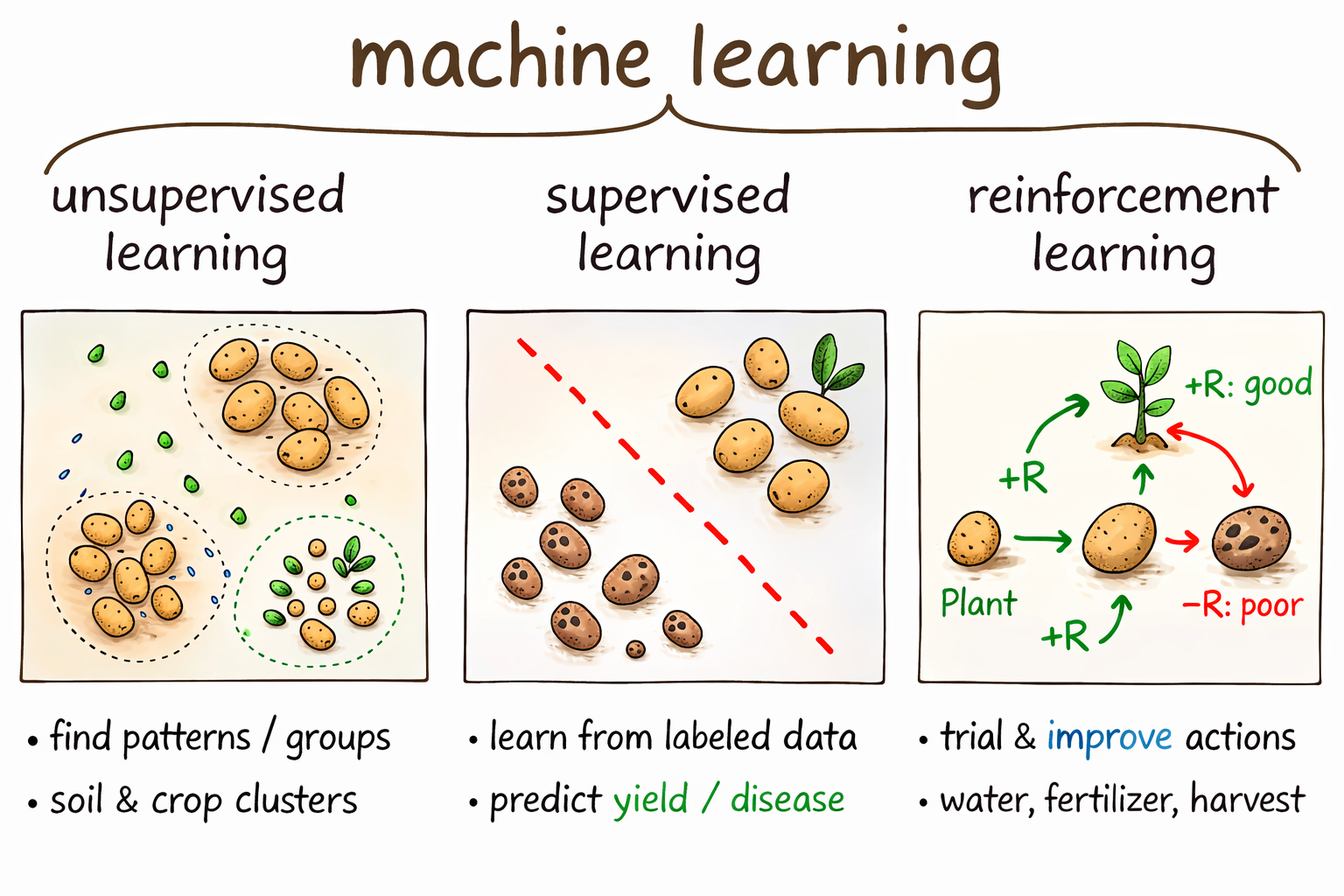
ML is a subset of AI where systems learn from data. There are two main types of ML: supervised and unsupervised learning.
Supervised Learning
Supervised learning is a type of machine learning where the system is trained on labeled data. The system is given a dataset with known inputs and outputs, and it learns to predict the output for new inputs.
Unsupervised Learning
Unsupervised learning uses unlabeled data. The system finds patterns, clusters, or structure without being told the “right” answer—useful for segmentation, anomaly detection, and exploring unknown data.
SiftAI — Vision-Based Sorting & Grading
SiftAI (Smart Vision Works / KPM Analytics) is an AI-powered machine vision system that inspects, sorts, sizes, and grades potatoes—and other produce—on the packing line with precision that often exceeds human graders.
What it does
- Scans each potato for defects, size, and grade in real time
- Operators set acceptable defect levels; SiftAI ejects non-conforming product (air jets, drop bars, etc.)
- Detects: bruises (old/new/pressure), rot, green, sprouts, growth cracks, misshapen, rhizoctonia, frozen, mud, and more
- Handles natural variation—designed for organic variation, not just uniformity
Why it matters
- Reduces labor and grader subjectivity; consistent quality
- Higher throughput, less waste, better yield vs. manual or older optical systems
- Web-based dashboards: defect logs, size distributions, throughput, ejection analytics
- Models updated regularly; can integrate into existing Hagan, Exeter, AgRay lines
What are Large Language Models (LLMs)?
LLMs are AI systems trained on huge amounts of text (books, articles, code, conversations). They learn patterns of language and can generate or understand text in a human-like way.
- Predict the next word (or token) given previous text
- Trained on billions of words
- Can follow instructions (“summarize”, “translate”, “answer”)
- Examples: ChatGPT, Claude, Gemini, Llama
More parameters (weights) and more training data → better at nuanced language, reasoning, and many tasks. “Small” models run on phones or edge devices; “large” ones usually in the cloud.
Machine Learning (ML) vs Generative AI (GenAI)
Machine Learning (ML)
- Learns from data to produce structured outputs
- Numbers: predictions, scores (e.g. yield t/acre)
- Categories: high/medium/low risk, yes/no
- Used for: forecasting, classification, optimization
Generative AI (GenAI)
- Generates new content: text, images, code
- LLMs are the main type for text
- Summaries, answers, drafts, alerts in plain language
- Makes ML results easier to read and act on
Together
ML produces the numbers; GenAI turns them into sentences. Example: ML predicts “F102 yield 16.9 t/ac”; GenAI writes “F102 is below target—consider scouting.”
ML, LLMs & Machine Vision — Examples
Concrete ways each type of AI shows up in agriculture and in the potato industry:
Machine learning (ML)
- Yield prediction: Model trained on soil, weather, variety, and past yields predicts t/acre for each field.
- Storage quality: Sensor data (temp, CO₂, O₂) → ML predicts sprouting risk or recommends “ventilate” vs “hold.”
- Price forecasting: Historical prices and market data → predicted price range for the coming month.
LLMs (GenAI)
- Summaries: “Turn last week’s field notes into a 3-sentence update for my partner.”
- Explaining data: “Why did F102 underperform?” → plain-language answer using your yield and weather data.
- Drafts & FAQs: Contract clauses, crew guidelines, or a chatbot that answers grower questions from your policies.
Machine vision
- Optical sorting: Cameras + ML classify potatoes by size, shape, colour, and defects in real time on the line.
- Disease diagnostics: Photo of a leaf → model suggests likely disease (e.g. late blight); you confirm with lab/agronomist.
- Hyperspectral: Many wavelengths of light detect quality or defects not visible to the eye—used in grading and research.
GenAI Popularity in Business
Surveys and reports show rapid adoption of GenAI in organizations.
Adoption
Many firms have piloted or deployed GenAI for documents, support, code, and analytics. Use cases range from drafting and summarization to customer chatbots and internal tools.
Why businesses use it
- Speed: drafts and summaries in seconds
- Consistency: same style and structure
- Scale: handle more content and queries
- Insight: turn data into readable reports
In agriculture
GenAI can summarize field reports, explain market or weather data in plain language, draft alerts and SMS, and answer questions over your own data when connected to your systems.
How LLMs Humanize and Process Data
Data is often in tables, logs, or technical formats. LLMs can turn that into clear language and help you work with it.
Humanizing data
- Summaries: “Last week’s yields” → “F101 and F103 on track; F102 below target—consider scouting.”
- Explanations: “Why did this field underperform?” using weather, soil, and history in plain English.
- Alerts and SMS: Short, actionable messages from numbers and rules.
- Reports: Turn spreadsheets and dashboards into narrative updates for management or partners.
Processing data
- Extract and structure: Pull key facts from long documents or notes.
- Translate format: Table → bullet list, technical → non-technical.
- Q&A over your data: Ask questions in natural language; LLM answers using your datasets (when connected via retrieval or APIs).
- Draft and edit: Propose text for forms, emails, or procedures from your inputs.
Prompt Example: Summarizing Data
No data, no audience, no format—the AI has nothing to work with.
Data, audience, length, and what to highlight are all specified.
Why This Training Matters
Stay competitive
AI tools are becoming essential in modern agriculture. Learning now positions your operation at the forefront.
Increase yields & reduce costs
Optimize planting, irrigation, and harvesting. Minimize waste and identify cost-saving opportunities.
Better decisions
AI-powered analytics provide insights from complex data for crop management, pricing, and market timing.
AI Use Cases in the Potato Industry
🌱 Crop & field
- Soil analysis & optimization
- Disease detection
- Yield prediction
- Crop monitoring (satellite, drones)
💧 Resources & storage
- Smart irrigation
- Storage: temp, gases, IoT
- Energy & inventory
- Equipment scheduling
📊 Business
- Market price forecasting
- Demand prediction
- Financial planning
- Risk assessment
Processes That Can Use AI and LLMs
Concrete areas where ML and LLMs fit into daily operations:
Onboarding
New staff or new growers: LLMs can draft orientation guides, answer “how do we…?” questions, and generate personalized checklists from your procedures. Reduces repeat questions and speeds ramp-up.
FAQ chatbot for farmers
An LLM-powered chatbot trained on your FAQs, policies, and ag content. Farmers and partners get 24/7 answers in plain language (varieties, storage, contracts, deadlines). You can refine answers and add new content as questions arise.
Storage algorithms
ML models optimize temperature, CO₂, O₂, and ventilation timing from sensor data and rules. LLMs can then explain recommendations in plain language (“Ventilate now because CO₂ is high and temp is rising”) so operators understand and trust the system.
Potato Apps: Sensors, LLMs & ML at Your Fingertips
Different tools on one device: storage control, AI alerts, and data insights.
Storage Control
Temp: 4.2°C ✓
CO₂: 2.1%
O₂: 18%
Sensors → ML → setpoints
Alerts
LLMs → SMS / in-app
Yield & demand
Demand forecast (ML)
Charts from ML models
Processes That Can Use AI and LLMs
Industry alerts
Ingest bulletins, weather warnings, pest/disease advisories, and market news. LLMs summarize and tailor alerts; ML can prioritize by relevance. Deliver by SMS, email, or in-app so the right people get the right message fast.
Pricing & weather
Pricing: ML forecasts prices; LLMs explain drivers and “what if” scenarios in plain language.
Weather: Ingest forecasts and historical data; ML for risk (frost, drought); LLMs for daily or weekly summaries (“Cool and wet next 5 days—delay irrigation”).
Demand forecasting
ML models predict demand by product, segment, or region from sales and market data. LLMs turn the numbers into narrative reports and scenario summaries for planning meetings and buyers.
Business Benefits: Things You Can Do
Reduce waste
Optimize inputs, irrigation, and energy so you use only what you need.
Improve yields
Use better planting timing, scouting, and crop management informed by data.
Save time
Automate record-keeping, reports, and routine admin where it makes sense.
Cut risk
Spot pests, disease, and weather issues earlier so you can act before they escalate.
Forecast prices
Use market and historical data to inform when and how to sell.
Plan demand
Align planting and storage with expected demand from buyers and markets.
Streamline operations
Schedule equipment and labour more effectively using forecasts and priorities.
Make better decisions
Combine data and AI insights with your own expertise to choose with confidence.
AI Implementation Strategy
1. Assess
Evaluate current operations and identify one clear opportunity
2. Plan
Set priorities and a simple roadmap
3. Pilot
Start small—one field or one process—and measure results
4. Scale
Expand what works; keep learning
Cultural Change and Adoption
Success with AI depends as much on people and process as on technology. Build adoption into how you work.
Cultural change
Treat AI as part of normal work, not a one-off project. Encourage curiosity, allow time to learn, and recognize that adoption takes time. Share both wins and lessons so the whole team can improve.
AI champions
Identify people who are willing to try tools first and share what they learn. Champions can demo use cases, answer questions, and help others get started. They don’t need to be technical—they need to be willing and visible.
Sharing best practice
Capture what works: good prompts, workflows, and use cases. Share internally (meetings, short guides, or a simple “tips” doc) and, where it makes sense, with peers in the industry so everyone benefits.
Embed AI into existing routines instead of treating it as extra work. For example: “We run the yield summary every Monday”; “Draft alerts go to the team before we send”; “New staff get the FAQ chatbot in their onboarding.” When AI is part of the workflow, adoption grows naturally.
Implementation Roadmap
Phase 1: Foundation (Months 1–3)
- Assess current operations
- Identify quick wins
- Select initial tools
- Train key staff
Phase 2: Pilot (Months 4–6)
- Implement pilot projects
- Collect and analyze data
- Measure ROI
- Refine approaches
Phase 3: Scale (Months 7–12)
- Expand successful pilots
- Integrate systems
- Build internal expertise
- Continuous improvement
Prompt Example: Market and Pricing
Too broad—no region, no use (sell vs. buy), no timeframe or audience.
Context (region, crop type), format, and audience make the answer useful. Adding files or actual data sources improves the answer.
Prompt Example: Storage and Operations
No readings, no targets, no constraints—the AI can’t give a concrete recommendation.
Current readings, targets, and constraints let the AI give an actionable answer.
Using AI Tools Effectively
- Goal: What you need (e.g. “Predict optimal planting date”)
- Context: Your situation (field, variety, location)
- Expectations: Format and detail (simple recommendation vs. full analysis)
- Source: Data to use (yields, weather, soil tests)
Effective: “Based on my 2020–2024 yield data and current soil temperature, recommend the optimal planting date for Russet Burbank in Field 3. Consider the 14-day forecast and give brief reasoning.”
Good vs. Vague Prompts
No context, variety, location, or data—AI can only guess.
Goal, context, data source, and format are clear.
Quality Assurance — Always Verify
- Verify numbers: dates, amounts, measurements against your records
- Check completeness: did the AI address all parts of your question?
- Apply your expertise: does the recommendation align with your knowledge?
- Consider context: is it right for your specific operation?
- Start low-risk; monitor results and adjust
AI Safety, Ethics and Liability
Principles
- Data privacy: Protect operational and personal data
- Verification: Always verify AI recommendations with human expertise
- Transparency: Understand how tools work and their limits
- Human oversight: Keep humans in charge of critical decisions
- Liability: You remain responsible for decisions—use AI to assist, not to replace your judgment; document what you checked
In practice
- Don’t input sensitive data unless the tool and policy allow it
- Use AI for drafts and analysis; you approve and act
- Report errors and odd outputs so others can learn
- Ethical responsibilities: Mandate clear roles (who verifies, who owns data), and consider a fair data ecosystem across the value chain
Case Study: AI in Potato Storage
Riverbend Storage Co-op needed to model temperature, CO₂, O₂, and IoT sensors—without in-house developers.
- Generated simulation code for temp and gas behaviour
- Turned storage rules (“if CO₂ > X and temp > Y, ventilate”) into executable logic
- Built pipelines to ingest sensor data and output “ventilation recommended” or “OK”
Getting Started — Next Steps
1. Identify
One challenge AI could address in your operation
2. Research
Explore AI tools used in agriculture and storage
3. Pilot
Start with one low-risk application
4. Measure
Track results and iterate